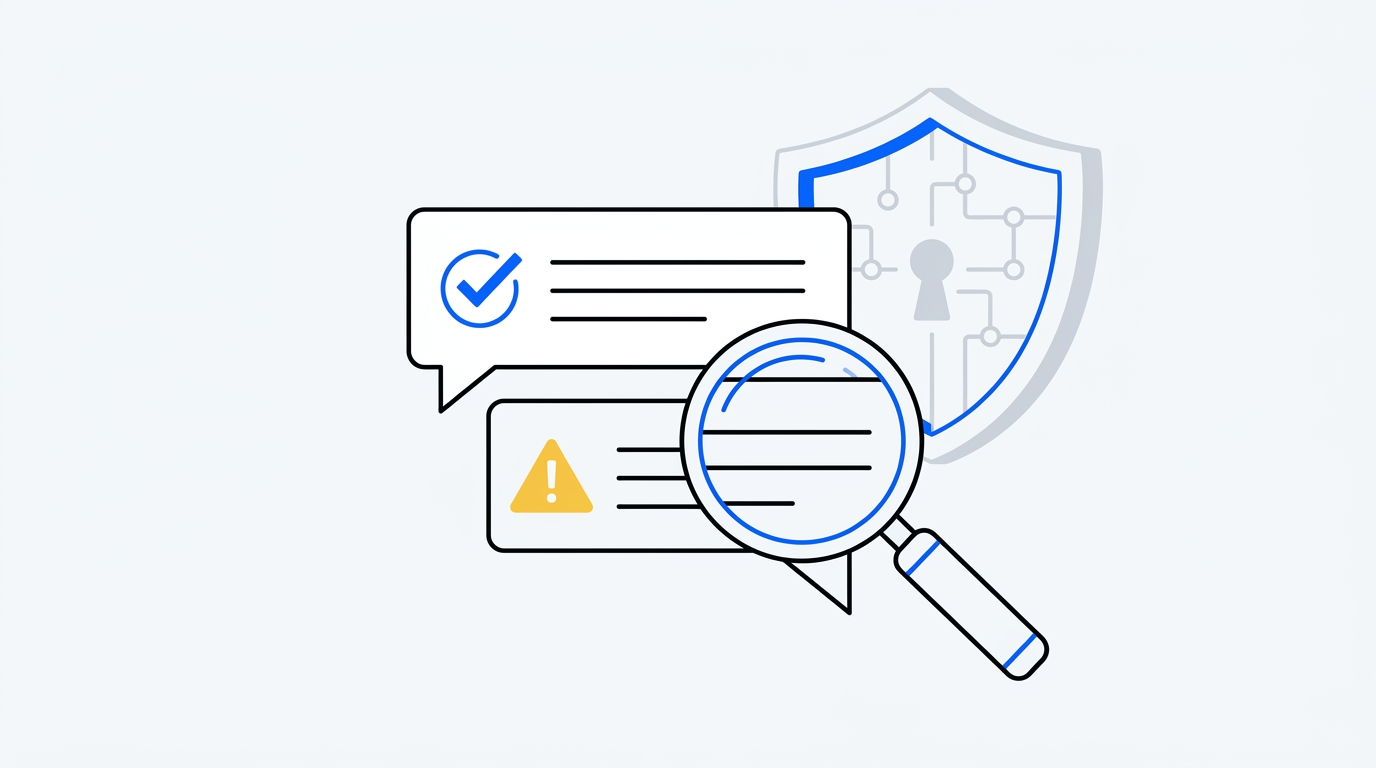
Your bank's AI assistant answers staff questions in seconds. That speed is the point. The problem is that nobody has checked whether those answers are correct.
Fifty-nine banking professionals searched last week to find out if AI assistants get Malaysian banking service timelines right. None found an answer on any bank's website. The risk it points to is operational, not theoretical.
General-purpose AI assistants draw on training data, not approved policy documents. Ask one about a chargeback window or a funds-transfer SLA and it replies with confidence. For banks under Bank Negara Malaysia or Monetary Authority of Singapore scrutiny, an unverified AI answer that spreads across an ops team is a process-governance problem. It carries an audit trail consequence.
The Chargeback Window That Spread Across an Ops Floor
Here is an illustrative scenario. It reflects a real mechanical risk.
A bank deploys a general-purpose AI assistant for its operations team. A junior ops officer asks: how long does the bank have to resolve a domestic debit card chargeback? The assistant replies: 14 days. The officer notes it, tells three colleagues, and the answer migrates into a shared internal page titled "Key SLAs."
The actual Bank Negara Malaysia-aligned window is different. It sits in an approved SOP. Nobody queried it because the assistant had already answered.
One confident, wrong answer, repeated across a team, becomes the working standard. The approved SOP sits untouched.
Why Banking Timelines Carry Particular Risk
Banking service timelines change. Regulatory updates, product relaunches, and internal redesigns all shift the numbers. A general-purpose AI assistant trained on an older data snapshot cannot reflect those changes unless someone updates the system context with current documentation.
Common timeline categories where AI assistants generate inaccurate or imprecise answers include:
- Interbank funds transfer clearing windows (IBG, DuitNow, PayNow equivalents)
- Card dispute and chargeback resolution periods
- Loan drawdown and disbursement SLAs
- Fixed deposit maturity and rollover notice periods
- KYC refresh and documentation expiry timelines
None of these numbers are static. All have regulatory reference points in MY and SG. An answer that was correct 18 months ago may not be correct today.
A 6-Step Fact-Check Protocol for Your AI Assistant
Run this against any AI assistant your ops team uses for timeline queries. One working session produces a dated, signed-off accuracy log. That is the artefact your audit team and regulators want to see.
-
Build a query set. List the ten most common timeline questions staff direct to the assistant. Cover both MY and SG SLAs if you operate in both markets.
-
Run each query and record the verbatim answer. Do not paraphrase. Exact language matters for the comparison step.
-
Pull your approved source document for each answer. This means your current SOP, the relevant BNM or MAS circular, or your published product terms — whichever governs the timeline.
-
Compare answer to source. Mark each query: Accurate / Inaccurate / Partially accurate (right range, wrong precision) / Unverifiable (no approved source exists).
-
Log discrepancies with date and source reference. A discrepancy is any answer the assistant gave with no traceable source in an approved document.
-
Assign a governance action per discrepancy. Correct the assistant's context, restrict the query category, or route it to an approved SOP source. The protocol produces a governance decision, not just a score.
Run this check quarterly, or whenever a significant regulatory update is issued. Keep the log as a dated internal record.
The Malaysia Picture
Bank Negara Malaysia's consumer protection and complaint resolution guidelines set specific windows that are public, citable, and subject to audit. A general-purpose AI assistant answering BNM-governed queries from training data has no guarantee of alignment with the current circular.
The 6-step protocol above is the minimum governance layer before any AI assistant is used for staff queries touching a regulatory timeline in Malaysia.
The Singapore Parallel
In Singapore, the Monetary Authority of Singapore's Technology Risk Management guidelines establish expectations around system accuracy and auditability. An AI assistant used for internal ops queries does not sit outside that scope simply because it is framed as a productivity tool.
If staff rely on it to action a process, the answer it gives is part of the operational control environment. MAS audit readiness means demonstrating that the information staff acted on was sourced from a current, approved document — not a model's training data.
How ESSAM Addresses This at the Source
The ESSAM answer to AI assistant accuracy is a different architecture, not a better prompt.
ESSAM's E-S-S-A-M method — Eliminate, Simplify & Standardise, Automate, Migrate — begins by capturing and approving your actual processes before any assistant is deployed. Those processes become the source of truth. ESSAM then deploys those standards over WhatsApp, the channel your staff already use. No new app. No adoption barrier.
When an ops officer asks a timeline question through ESSAM's WhatsApp deployment, the answer comes from the SOP your compliance team approved. If that SOP changes — after a BNM circular, a product revision, or an internal policy update — the deployed standard changes accordingly.
There is no gap between what the assistant says and what the document says. That gap is where hallucination risk lives. Closing it is what regulators look for in an audit trail.
Frequently Asked Questions
How do I know if my bank's AI assistant is giving accurate timeline answers?
Run the 6-step fact-check protocol above. For each query, compare the verbatim answer to your current approved SOP or the relevant regulatory circular. Any discrepancy without a traceable approved source is a governance finding, not just an accuracy note.
Does MAS TRM apply to internal AI assistants used by operations staff?
Broadly, yes. If staff rely on an AI assistant to action a process or apply a service timeline, that tool is part of the operational control environment. MAS TRM expectations around accuracy, auditability, and change management apply to the information driving staff action — regardless of what the tool is called.
What is the difference between a general-purpose AI assistant and an SOP-sourced assistant?
A general-purpose AI assistant generates answers from training data. An SOP-sourced assistant retrieves answers from your organisation's current approved documents. The distinction matters for regulatory accuracy: training data can be stale or misaligned with your specific policies. Approved SOPs are dated, signed off, and traceable.
ESSAM maps your processes, identifies gaps, and deploys approved SOPs over WhatsApp — so staff get answers sourced from your compliance team's documents, not from a model's prior training. Book a demo on your process. Your actual workflow. No hypothetical use case required. apac.essam.ai/contact
Related reading: WhatsApp SOP deployment guide · AI process automation in Malaysian banking · MAS TRM process evidence and audit