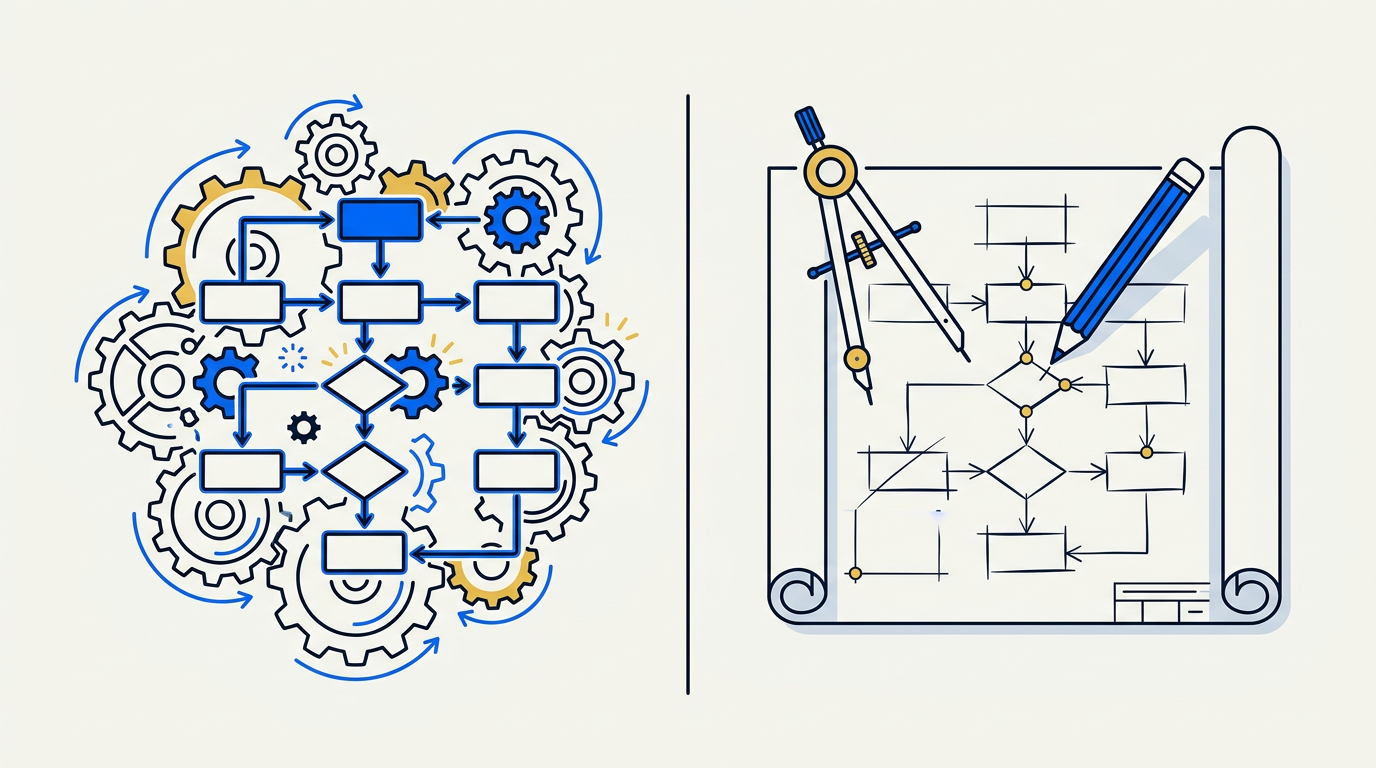
A BPMN engine will run your process at 10,000 executions per second. It cannot tell you the process is wrong.
That distinction matters more than most evaluation frameworks admit. Before your dev team goes deep on a developer-grade BPMN workflow engine, it is worth being precise about what the problem actually is.
The category error hiding in your evaluation scorecard
Most workflow engine evaluations are excellent answers to the wrong question. They score throughput, deployment flexibility, cluster support, and audit trails. All legitimate criteria. But throughput of what, exactly?
A workflow engine is a runtime. It executes the process diagram you give it. Give it a well-designed process and it runs that process reliably at scale. Give it a poorly-designed process and it runs that poorly-designed process reliably at scale.
The engine does not know the difference. That is not a flaw; it is the correct scope for execution infrastructure.
The category error arrives when a team treats diagram completion as the hard part. The hard part is knowing whether the diagram reflects how work actually moves. Where does waste live? Which steps exist for compliance versus institutional habit, and which handoffs will break under volume?
Roughly 390 monthly searches for "business process modelling notation" indicate strong practitioner awareness of the notation itself. Searches for "is my process model correct" return nothing measurable. The notation is famous. Whether the model is any good is nobody's query.
What BPMN engines are genuinely excellent at
This is a fairness note, not a caveat: open-source BPMN engines are exceptional execution infrastructure. They handle high-volume deterministic workflows with version control, audit logging, and developer-friendly tooling. If your process is well-designed, a BPMN engine will run it faithfully at production scale.
The workflow engine you are evaluating is probably fine as an engine.
Understanding workflow engine limitations is not about criticising the tooling. It is about acknowledging what any execution layer requires from the organisation before it can do its job: a process that has been designed, not merely documented.
In a public orchestration discussion from 2026, practitioners noted a recurring pattern. Teams spend months instrumenting a workflow engine against a process that was never baselined. The process runs. Metrics are collected. Nobody is confident the metrics measure the right thing.
The sequencing problem
E-S-S-A-M exists precisely because Automate is the fourth action, not the first. The framework — Eliminate, Simplify & Standardise, Automate, Migrate — is explicit that you cannot automate your way out of a design problem.
Most automation projects skip to step four. They diagram current-state, drop the diagram into the engine, and call it process improvement. Current-state automation is process preservation with better uptime.
Eliminate comes first. Before you model anything, you need to know which steps should not exist. Steps that survive only as institutional habits, approvals duplicated across departments, gates with no downstream decision attached — these are waste before they are workflow.
Simplify & Standardise comes second. Before you automate a handoff, you need to know whether it can be collapsed, and whether the variation in how different branches handle it is meaningful or arbitrary.
Only then does Automate belong in the conversation. A BPMN diagram built after Eliminate and Simplify will be structurally different — and measurably shorter — than one built against current-state.
ESSAM captures this in a single conversational session. No notation software. No workshop preparation. The output includes the before/after audit view, SOPs, SLAs, RACI, and policy documentation drawn directly from the live model. The same session identifies all eight MUDA waste types automatically and can run FMEA before go-live.
If your team then chooses to export that model into a BPMN engine, the diagram the engine receives is designed rather than transcribed.
An analogy from procurement [REAL — procurement engagement]
By analogy, a Kuwait bank applied design-before-orchestrate sequencing to its procurement cycle. The cycle ran at 139 days. The team expected automation to fix it. Analysis found that the gains came almost entirely from Eliminate and Simplify — before a single automation was deployed. The cycle landed at 57 days: a 59% reduction, 82 days of work retired, and a 106.9% efficiency improvement at the same headcount.
The engine could have run the 139-day process faster. It would still have been 139 days of process.
Picture a regional bank in Singapore evaluating a developer-grade BPMN engine for its trade-finance approval chain — a purely illustrative scenario. The dev team builds the diagram, integrates the engine, and runs UAT. Throughput is excellent. Three months later, the ops lead flags that the 14-step approval sequence still contains four steps that exist because a regulation was repealed in 2019. The engine ran them faithfully the entire time.
When to buy an engine versus when to design first
The decision is not "engine or platform" — it is sequencing. The table below maps the signal to the right entry point in the bpmn engine vs process engineering conversation.
| Signal | Right entry point |
|---|---|
| Process is well-documented, stable, confirmed as optimised | Workflow engine — execution infrastructure is the gap |
| Process is documented but never baselined against actual waste | Design phase first; engine after Simplify & Standardise |
| Process is undocumented or practiced inconsistently across branches | Capture and analyse before any tooling decision |
| High execution volume, low process complexity | Engine is likely correct; validate with a short baseline session |
| Compliance-critical process with unclear ownership | RACI and policy documentation must precede automation |
| Process has been "automated" before but gains were marginal | Category error likely; return to Eliminate |
"Engines execute decisions," says Abdulla Al-Awadi, ESSAM's founder and former Chief Strategy Officer at a Kuwait bank. "They don't make them. If you hand an engine an undesigned process, you get a faster version of the same problem."
What an AI-native ops platform adds to the conversation
ESSAM is not a competing workflow engine. It is what happens before the engine receives the diagram — or instead of the engine, if orchestration is not the right solution for the complexity level.
The platform captures processes conversationally, surfaces waste across the E-S-S-A-M sequence, and documents the designed state including SOPs, policies, and RACI. It can output into downstream orchestration if that is the team's chosen path. WhatsApp deployment means adoption in Singapore and Malaysian banking teams does not require a new tool rollout or training cycle.
The workflow engine alternative is not always a different engine. Sometimes it is a design phase that makes the engine's job tractable — and the diagram worth running.
Book a demo on your process. Your actual workflow. No hypothetical use case required.
Related reading: Workflow orchestration explained · AI process automation vs RPA in banking · Features