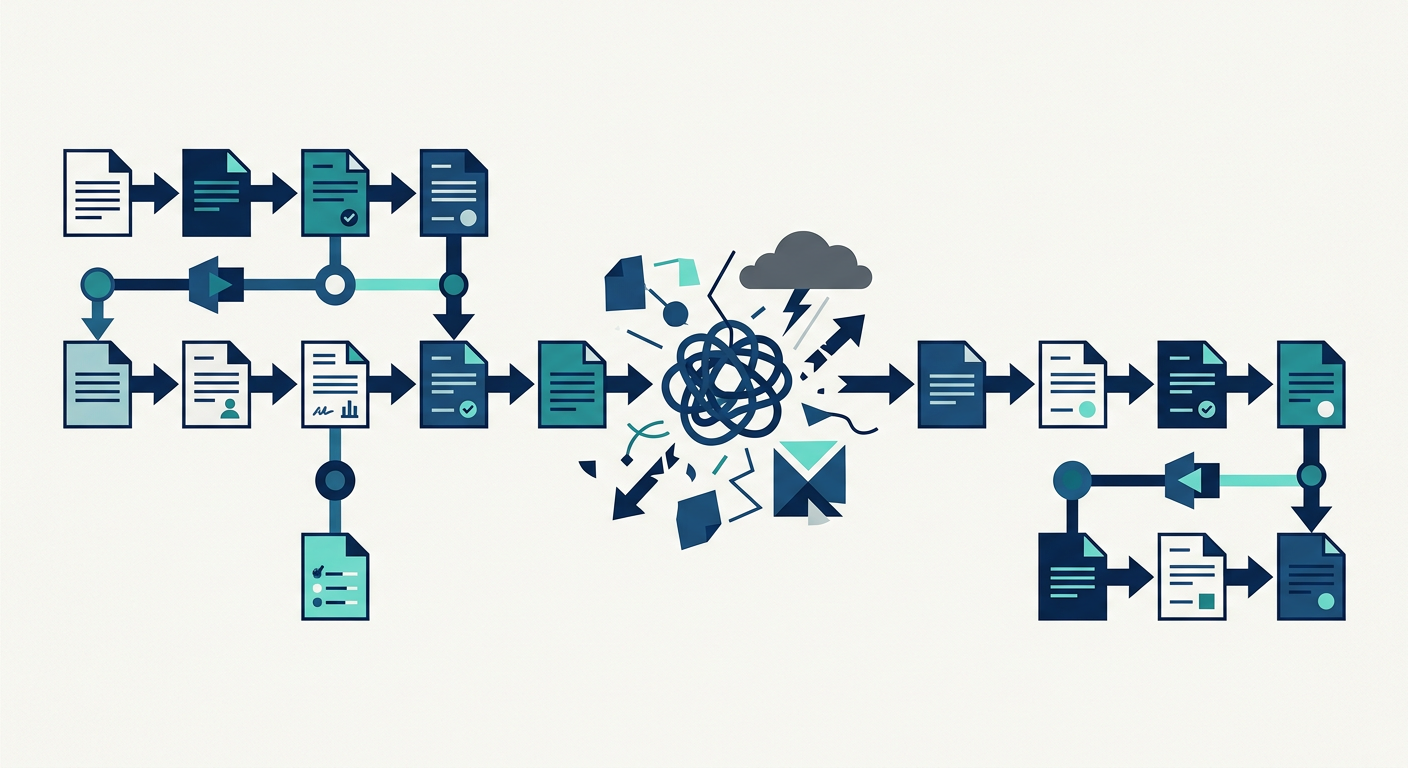
Procurement cycle time is decided before the first transaction. The days your institution loses are not sitting in your ERP, your AP automation, or your PO workflow. They are in the stage most procurement teams in Singapore and Malaysia have never drawn on a whiteboard: intake-to-contract.
Procure-to-Pay Has a System. Intake-to-Contract Has an Inbox.
Every bank and GLC in the region has invested in procure-to-pay. Invoice capture, three-way matching, payment runs — these steps are documented, measured, and in many cases automated. Cycle time for the transactional half is tracked to the day.
But ask a procurement or finance-ops lead to draw the flow from "we need a vendor" to "PO raised" and most will pause. Some describe a chain of emails. Others reference a shared drive with templates that may or may not be current. A few name an individual — "it goes through Farah" — as though a person is a system.
That is the intake-to-contract problem. Not a technology gap. A governance gap dressed up as a process.
The four stages that compose intake-to-contract are:
- Requisition intake — A business unit identifies a need and submits a request. Or sends an email. Or messages someone on WhatsApp, depending on what day it is.
- Approvals — The request routes through finance, compliance, legal, and sometimes a technology committee, in an order that varies by vendor type, contract value, and institutional memory.
- Vendor selection — Shortlisting, RFP, or direct award, depending on thresholds that may exist in policy but may not be enforced in practice.
- Contract drafting and execution — Legal drafts, counterparty redlines, internal sign-off, wet or digital signatures.
None of these four stages appears in your ERP as a time-stamped workflow. None carries a defined SLA in most institutions. When cycle time is long, the explanation is almost always a stage that falls inside this half: "legal took three weeks," "we were waiting on compliance sign-off," "the request came in wrong and had to be resubmitted."
That explanation is accurate. The diagnosis beneath it — that intake-to-contract has no designed flow — is what rarely gets addressed.
The Vendor That Nearly Expired
Picture a procurement team at a mid-sized bank. A critical infrastructure vendor is due for renewal. The relationship manager sends a note to the business unit head eight weeks before expiry. The business unit head forwards it to procurement. Procurement raises a requisition, but the form has no expiry-date field, so no deadline is recorded.
The request routes through the standard approval chain: finance, then IT risk, then legal. Legal receives it two days before the contract expires.
Not because legal was slow. Because intake never created a deadline the approval chain could honour.
The vendor gets an emergency extension. The bank pays a penalty rate for the gap period. The business unit head sends an escalation. Procurement responds with a post-mortem. The post-mortem recommends "earlier notification." Nobody maps the intake flow to find where the deadline was lost.
That is an illustrative scenario. It is also a description of what happens when intake-to-contract runs on memory rather than design.
Why the Days Hide Here
Procure-to-pay automation is built on transactions. Every tool in the category — from banking procurement process optimisation platforms to AP-automation point solutions — optimises the steps that touch money: the order, the receipt, the invoice, the payment.
Intake-to-contract touches decisions. And decision workflows are harder to instrument because they involve human judgement at every gate: Is this vendor approved? Does this spend need a committee? Is the contract non-standard? Is the risk rating acceptable for this counterparty?
Because intake-to-contract involves judgement, most institutions have not tried to systematise it. They have relied on experienced staff to route requests correctly, escalate when necessary, and chase approvals when things stall. That works until those staff leave, go on leave, or have too many requests in flight at once.
The result is cycle time that cannot be explained by any single step — because no single step has been measured.
The Kuwait Case: Where the Delta Actually Came From
[REAL outcome — Kuwait banking institution]
A banking institution in Kuwait was running a procurement cycle of 139 days, measured from first requisition to final payment. That number was accepted as the baseline. No automation projects were in flight. No new systems were under evaluation.
When the cycle was mapped in full — including the stages before the first transaction — the intake-to-contract half accounted for the majority of elapsed time. Duplicate approval routes sent the same request to different stakeholders at different stages. Vendor selection criteria were not documented, so shortlisting was re-litigated each time. Contract templates were not standardised, so drafting started from scratch on every engagement.
After applying Eliminate and Simplify & Standardise — the first two actions in the E-S-S-A-M framework — and before any automation was introduced, the cycle fell from 139 days to 57 days. A 59% reduction. Eighty-two days of work retired at the same headcount.
The transactional half of the cycle, the half with the ERP and the AP automation, contributed a small portion of that improvement. The intake-to-contract half, the half with no system of record, is where the delta came from.
If you have already automated procure-to-pay and your vendor onboarding cycle has not changed, look upstream.
See the full analysis in the banking procurement case study.
The Stage-Aging Table
Most institutions cannot produce this table from existing data because intake-to-contract is not in their systems. If you could instrument each stage, here is what the distribution typically looks like:
| Stage | Median Elapsed Days | Common Delay Cause | System of Record? |
|---|---|---|---|
| Requisition intake | 3–7 days | Incomplete submission, wrong template, email routing | Rarely |
| Approval routing | 14–28 days | Sequential rather than parallel gates, no SLA per approver | Sometimes |
| Vendor selection | 10–21 days | Undocumented criteria, manual shortlisting, re-approval on price | Rarely |
| Contract drafting and execution | 15–30 days | Non-standard templates, counterparty redlines, wet signature dependency | Sometimes |
| Total intake-to-contract | 42–86 days | Accumulated across four unmanaged stages | Almost never |
Note: these are indicative ranges based on common intake-to-contract patterns in regulated-industry procurement, not client data. The Kuwait outcome (139 to 57 days) is a verified real result from a single banking institution.
If your institution measures vendor onboarding cycle time but does not break it down by stage, you are measuring an outcome, not a process. The cost of each unmeasured day is real even when it is invisible.
What E-S-S-A-M Finds When It Analyses Intake-to-Contract
The E-S-S-A-M framework — Eliminate, Simplify & Standardise, Automate, Migrate — classifies every step by the action it needs. When applied to a typical bank's intake-to-contract flow, the pattern is consistent.
Eliminate surfaces most readily in approval routing. Duplicate approval chains — where the same request is reviewed by a finance director at intake and again at contract execution, or where two committees with overlapping mandates both gate the same vendor category — do not add information. They add elapsed time and, occasionally, contradictory outputs.
Simplify & Standardise applies to vendor selection criteria and contract templates. When shortlisting criteria exist only in the knowledge of the person who ran the last RFP, every new RFP re-starts from scratch. Standardising the criteria does not constrain judgement — it captures the judgement that already exists and makes it reproducible.
Automate is the fourth action in E-S-S-A-M, deliberately. You do not automate a flow you have not yet designed. Banks that have tried to automate intake-to-contract before mapping it have built workflows that replicate the existing confusion at higher speed.
Migrate identifies which approval steps could move to a different, lower-cost channel once the flow is designed — for instance, routing standard-template renewals below a value threshold to a digital approval channel rather than a committee.
The sequencing matters. Eliminate the duplicate routes first. Standardise second. Automate what remains. The Kuwait outcome was achieved on Eliminate and Simplify alone.
The 7-Step AI Lean Cycle: What "Document and Approve" Changes
ESSAM's 7-step AI Lean Cycle runs: Baseline → Map → Analyse Waste → Optimise → Document and Approve → Deploy → Improve.
The Document and Approve step is where intake-to-contract gains its first real governance structure. Until a process is documented and approved by its owners, it exists only in institutional memory. This step does two things specific to the intake-to-contract problem.
First, it turns a tribal approval chain — "it depends on the value, the vendor category, and who is available" — into a designed approval chain with named owners, defined thresholds, and a written SLA per gate. This is not added bureaucracy. It is the difference between a process that operates consistently and one that operates differently each time.
Second, it creates the baseline that makes the before/after audit view meaningful. You cannot measure improvement against an undocumented process. Once the intake-to-contract flow is documented and deployed as a living workflow, every subsequent run generates data: time at each stage, approver response time, submission completeness rate. That data is what allows procurement and finance-ops leads to move from reporting cycle time to managing it.
The "Draw the Unmapped Half" Exercise
Before any system is introduced, try this exercise with your procurement team. It takes 30 minutes and produces more diagnostic value than most formal assessments.
Ask each person involved in intake-to-contract to independently draw the flow from "vendor request received" to "PO raised." Give them a blank page. No templates.
Then compare the maps.
In most institutions, you will find:
- Two or three different starting points (email, form, verbal request)
- Different approval sequences depending on who drew the map
- At least one step that appears on some maps but not others
- No agreed handover point between stages
The divergence in those maps is the process gap. It is not a training issue or a communication issue. It is the absence of a designed flow. What lives in its place is a collection of individual interpretations of a policy written for a different era of the business.
ESSAM's single-session capture maps this flow in one conversation. The AI asks guided questions and the process owner answers. The output is a structured map reflecting what actually happens, not what the policy manual says should happen. That map then goes through the Document and Approve step, where owners align on the designed version.
The gap between those two maps — actual versus designed — is your improvement opportunity.
The Intake-to-Contract Mapping Checklist
For each of the four stages in your intake-to-contract flow, answer these four questions. If you cannot answer all four from existing documentation, the stage is unmanaged.
Stage 1: Requisition Intake
| Field | Your Answer |
|---|---|
| Trigger | What event initiates a vendor request? Email, form, verbal, WhatsApp? |
| Owner | Who is responsible for receiving and validating the request? |
| SLA | How many days does intake-to-handoff take? Is this documented? |
| System of record | Where is the request logged so all stakeholders can see its status? |
Stage 2: Approval Routing
| Field | Your Answer |
|---|---|
| Trigger | What criteria determine which approval gates apply? Value threshold, vendor category, contract type? |
| Owner | Who owns the routing logic — not the approvers, but the routing decision itself? |
| SLA | What is the maximum elapsed time per approver? Is this enforced? |
| System of record | Where is approval status visible to the requester without them needing to chase? |
Stage 3: Vendor Selection
| Field | Your Answer |
|---|---|
| Trigger | When does a request move from "approved to proceed" to "vendor selected"? |
| Owner | Who owns the shortlisting process? Are criteria documented? |
| SLA | What is the expected elapsed time for selection, by contract value band? |
| System of record | Where is the selection rationale recorded for audit purposes? |
Stage 4: Contract Drafting and Execution
| Field | Your Answer |
|---|---|
| Trigger | What initiates contract drafting — vendor selection confirmation, or something else? |
| Owner | Is legal the owner, or is there a contract manager who owns the milestone? |
| SLA | Is there a drafting-to-signature SLA? Does it apply to counterparty redlines? |
| System of record | Where is contract expiry tracked so that renewals enter intake with a deadline? |
Any blank in this checklist is a day that is currently unmanaged. The aggregate of those blanks is your intake-to-contract cycle time.
What Designed Intake-to-Contract Looks Like in Practice
With the flow mapped, documented, and deployed, the before/after audit view becomes operational. ESSAM's audit view shows time-at-stage for every active and completed request: how long each intake sat before it was routed, which approval gates created the most delay, where contract drafting stalled.
This is not a reporting dashboard. It is a management view built for intervention. A procurement lead who sees contract-stage aging climbing in week three of a quarter can act on it that week — not in a post-mortem six months later.
Living work instructions, delivered over WhatsApp to the teams running the process, update automatically when the designed flow changes. When a new approval threshold is introduced, every team member receives the updated instruction in the channel they already use. There is no retraining cycle. There is no PDF that is emailed and forgotten.
The features page covers how single-session capture, the E-S-S-A-M classification, and the before/after audit view work together.
Procurement Cycle Time Is Decided Before the First Transaction
If your bank automated POs and invoicing two or three years ago and your vendor onboarding cycle has not shortened, the remaining time is upstream. It is in the intake, the approvals, the selection, the drafting. It is in the half of the cycle that has no system, no SLA, and no owner.
Map it before you automate it. Eliminate the duplicate approval routes before you build a workflow around them. Standardise the contract templates before you automate the drafting. The Kuwait outcome — 139 to 57 days, at the same headcount, before any automation — is what happens when you apply that sequence.
The first step is drawing the unmapped half. Most procurement and finance-ops leads in Singapore and Malaysia have not done it yet. That is the gap. That is also the opportunity.
To map your intake-to-contract flow in a single session, visit apac.essam.ai.