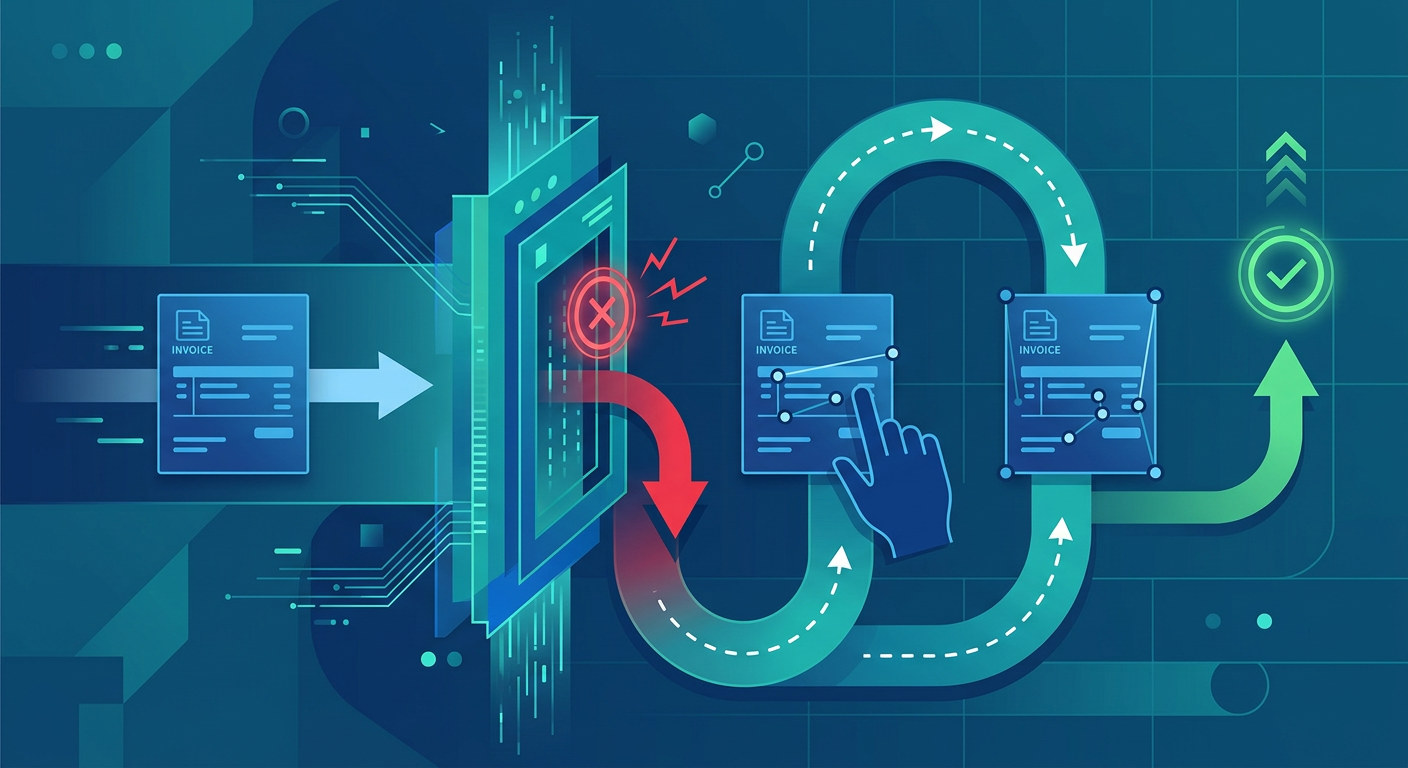
The MyInvois mandate is a compliance deadline on paper. In practice, it is a finance-ops redesign — one where the validation rejection queue, not the submission API, becomes the daily work of your AP team.
The Question No Integration Project Plan Answers
Most Malaysian finance teams are treating MyInvois as an IT integration project. Connect the ERP to LHDN's system. Pass the technical test. File the acceptance certificate. Done.
That framing is accurate and dangerously incomplete.
The integration test runs on clean, controlled data. Week one in production runs on every messy edge case your business has accumulated over the past decade: buyer TIN numbers that do not match LHDN's register, invoice line items that fail classification rules, credit notes raised against invoices that were submitted but not yet validated. The ERP submits the e-invoice. The validation engine decides whether it stands. When it rejects — and it will — someone has to own that rejection before the month closes.
That someone is usually your AP clerk. They are almost certainly not part of the integration project.
This is the hidden cost of the mandate: not the technology, but the process discipline the technology now requires. Finance teams that treat this as a compliance project will meet the deadline. Finance teams that treat it as a process redesign will have a functional first quarter.
What the LHDN MyInvois Phased Rollout Actually Requires
LHDN's MyInvois mandate is structured as a phased rollout, grouped by annual turnover thresholds. The largest businesses were brought into the mandate first; smaller entities follow in successive tranches. Current effective dates and precise turnover bands are published by LHDN directly — check the official MyInvois portal rather than quoting a date from a secondary source, as timelines do update.
What does not change across phases is the underlying obligation. Every covered entity must:
- Generate a structured e-invoice in the mandated format (UBL 2.1-based XML or JSON)
- Submit it to MyInvois for validation before it constitutes a valid tax document
- Receive a Validated status and a UUID from LHDN before sharing it with the buyer
- Share the validated e-invoice — with UUID and QR code embedded — to the buyer within defined timelines
- Handle rejections, cancellations, and credit-note scenarios within LHDN's prescribed windows
That final obligation is where the compliance project ends and the finance-ops redesign begins. The first four points are integration work. The fifth is process work. Most implementation budgets fund the first four.
Singapore's InvoiceNow Parallel: A Useful Reference Frame
Singapore finance teams are watching a parallel story unfold under InvoiceNow, the IMDA-driven adoption of the Peppol network for structured business-to-business e-invoicing. The architecture differs from MyInvois: Peppol operates on a network-to-network model, routing documents through accredited access points rather than a central government clearance authority. But the operational challenge is structurally identical.
Both mandates assume your data is clean, your master records are current, and your counterparties are registered on the relevant network or registry. None of those assumptions are universally true at go-live.
For SG teams running cross-border operations into Malaysia — or managing shared-service centres across both markets — the readiness work compounds. InvoiceNow compliance does not give you MyInvois readiness. They are separate validations, separate error taxonomies, and separate failure modes. The process-redesign logic underneath them is the same: the mandate forces data and workflow discipline that your current AP flow does not have.
Teams working across both markets will find relevant grounding in cross-border regulatory process mapping for SG and MY. The principle there applies directly: mandates that look like reporting requirements are, in practice, process requirements.
The Week-One Story No Integration Deck Mentions
Consider a mid-sized trading company: manufacturing supply chain, a finance team of four, two dedicated AP clerks. The IT project completes on schedule. The vendor certifies successful test submissions. The go-live date arrives.
By Wednesday of the first week, the rejection queue holds fourteen invoices. Three have buyer TIN entries that do not match LHDN's registry — the buyer updated their registration and nobody notified the AP team. Two fail on address-format validation. Four have line-item descriptions that exceed the character limit — a limit that never existed in their previous invoicing system. Five are held because a credit note was raised against an invoice that had been submitted but not yet validated, creating a sequencing conflict the system does not know how to resolve.
The AP clerks have no correction workflow. The finance system flags the rejections but does not route them. The finance manager discovers the backlog on Friday when a key buyer calls asking why their validated invoice has not arrived. The month-end reconciliation now carries a gap: rejected invoices are not valid tax documents, which means revenue recognition for those transactions is in question until they are corrected and resubmitted with new UUIDs.
The integration passed every test. The process was never mapped.
The Rejection-Handling Flow: Detect, Route, Correct, Resubmit, Record
When MyInvois rejects an e-invoice, it returns a specific error code. The categories are documented by LHDN: invalid TIN, incorrect e-invoice type, format violations, duplicate invoice numbers, and more. What most implementation guides do not cover is who owns each error type and what the correction path looks like in practice.
A workable rejection-handling flow runs through five stages.
Detect. The system confirms a rejection and flags it with the LHDN error code. This should be an automated alert — not a manual status check. If your AP clerk discovers rejections by logging into the MyInvois portal each morning, you have a process gap on the first step.
Route. Each error code maps to a different owner. TIN mismatch routes to the master-data team. Format errors route to the ERP administrator or implementation partner. Content errors — wrong buyer details, wrong address, wrong e-invoice type — route to AP or the originating sales team. Without a routing rule, everything defaults to the AP clerk. The AP clerk then improvises a fix, which often creates new errors.
Correct. The correction action depends on the error type. Some errors require a new invoice number. Others require a formal cancellation of the submitted invoice and a fresh submission. Credit-note scenarios have their own timing windows and sequencing requirements. The correction path must be documented before go-live, not designed under pressure at month-end.
Resubmit. The corrected document is submitted to MyInvois as a new or amended submission. A new UUID is issued on validation. The ERP record must be updated to carry the validated UUID — not the originally-submitted version. This is a data-integrity step that most ERP integrations do not handle automatically.
Record. The audit trail must capture the original submission, the rejection reason, the correction action, and the final validated resubmission. This is the chain of custody LHDN will want in an audit. It is also the record your controller needs to close the books cleanly.
If your current AP process has none of these steps formalised, you do not have an integration gap. You have a process gap. The integration will pass testing. The process gap will surface in week one.
The regulatory reporting process-mapping playbook covers this pattern more broadly: mandated reporting requirements that look like technology integrations almost always contain an uncosted process redesign at their core.
Applying E-S-S-A-M to MyInvois Mandate Readiness
The E-S-S-A-M framework — Eliminate, Simplify and Standardise, Automate, Migrate — provides a practical triage sequence for finance-ops teams assessing their invoice process before go-live. The sequence matters: Automate is the fourth action deliberately, because automating an unexamined process embeds its problems at machine speed.
Eliminate. Which steps in your current invoice-to-payment flow produce no value under the mandated model? Manual TIN lookups for regular buyers who could sit in validated master data. Duplicate approval stages for invoices below a materiality threshold. Archiving PDF invoices to shared drives that the mandate now supersedes. Eliminate these before mapping anything else.
Simplify and Standardise. Standardise your invoice data fields to match MyInvois specifications: buyer TIN format, registered address format, line-item description length, e-invoice type classification for each of your transaction types. Simplify the master-data maintenance process so a buyer record update flows automatically to your invoice template. If this step requires a policy change — for example, making TIN verification mandatory at buyer onboarding — that policy change is part of the mandate readiness project.
Automate. Only after you have standardised should you automate. Automate the submission trigger. Automate the validation-status polling. Automate the rejection alert and initial routing by error-code category. These automations are only clean if the underlying data is standardised first.
Migrate. Where your current process depends on tools or systems that cannot support MyInvois natively — legacy billing software, Excel-based invoice generation, manual PDF dispatch — the migration path is its own project track. This is typically the longest lead-time item and the one most likely to be underestimated in the integration schedule.
E-S-S-A-M is not a checklist for your systems integrator. It is a triage tool for your finance-ops team. The people who know which steps to eliminate are your AP clerks and your finance manager.
Finance-Ops Readiness Map: MyInvois and InvoiceNow
The table below maps seven stages of the MyInvois finance-ops lifecycle against the accountable owner, the most common failure mode at each stage, and the fix path. The InvoiceNow (SG) column notes where the two mandates diverge materially.
| Stage | Owner | Common Failure Mode | Fix Path | InvoiceNow SG Note |
|---|---|---|---|---|
| Master-data preparation | Finance ops / master-data team | Buyer TIN unregistered or mismatched with LHDN registry | Bulk TIN verification before go-live; SOP for new-buyer onboarding | Peppol ID registration for counterparties; access-point readiness check |
| Invoice generation | ERP / billing team | Format errors: field overlength, mandatory fields missing, wrong e-invoice type | Pre-submission validation layer in ERP; map e-invoice types to each transaction category | UBL 2.1 format; submission routes through access point, not direct to LHDN |
| Submission and validation | ERP / integration layer | Network timeouts, duplicate submissions, unhandled validation rejections | Submission-status polling; duplicate-check logic; reject-code catalogue with owner map | Access point handles delivery confirmation; network SLA differs from LHDN clearance model |
| Rejection handling | AP + master-data + ERP admin | No routing rule; corrections improvised; audit trail incomplete | Rejection-handling SOP by error-code category; correction window tracked per error type | Same five-stage logic applies; specific rejection codes differ by access-point implementation |
| Credit note and cancellation | AP + controllership | Credit note raised against an unvalidated invoice; cancellation window missed | Credit-note workflow gated on validated status confirmation; cancellation deadline tracked | SG cancellation and amendment rules are governed by Peppol network policy; verify current version |
| Month-end reconciliation | Finance / controllership | Open rejection queue not resolved; ERP carries unvalidated UUIDs | Month-end close checklist includes open rejection queue as a hard gate; ERP updated with validated UUIDs | Reconcile Peppol delivery receipts and access-point acknowledgements against ERP records |
| Audit readiness | Finance / compliance | Correction history not captured; original submission not retained alongside resubmission | Audit trail captures: original submission, rejection reason, correction action, resubmission, validated UUID | IMDA audit requirements; access-point retains delivery logs; confirm retention period with your access point |
This map is what your integration project will not produce. It is produced by mapping your actual invoice process — current state, not future state — and identifying where ownership breaks down under rejection conditions.
For organisations operating in both markets, this readiness exercise has a direct parallel in the governance process-mapping work relevant to BNM's operational risk requirements, covered in BNM risk governance and operational process mapping. The ownership and audit-trail disciplines are the same.
The 7-Step Cycle: Why Document Matters Most Here
ESSAM's 7-step AI Lean Cycle — Baseline, Map, Analyse waste, Optimise, Document, Deploy, Improve — has one step that matters disproportionately for MyInvois readiness: Document.
The mandate does not only require you to submit e-invoices. It creates an implicit requirement for an audit trail: the chain of custody from original invoice to validated document, including every rejection and correction in that chain. LHDN can request this trail. Your external auditor will examine it. Your controller needs it to close the books.
The Document step is where this audit trail lives as a living, queryable work instruction rather than a static PDF. A documented rejection-handling process — who does what, in which system, by which deadline, producing which record — is what makes month-end reconciliation tractable and what makes an LHDN compliance inquiry manageable rather than disruptive.
Most teams will build this documentation after their first painful close. Teams that build it before go-live will have a materially smoother first quarter. The discipline required is the same discipline covered in regulatory reporting and process mapping: document the process while it is being designed, not after it has already broken.
Single-Session Capture: Map the Current State Before the Mandate Changes It
The most practical thing a finance-ops team can do in the 60 days before their MyInvois phase goes live is map their current invoice process — not the future-state integrated version, but the current-state version, with all the workarounds and informal knowledge your AP clerks carry.
This is the Baseline step in the 7-step cycle. ESSAM captures it in a single conversation. The AP clerk, the finance manager, and the controller walk through the invoice flow from PO receipt to payment confirmation. The AI captures every step, classifies each one against E-S-S-A-M, and surfaces the waste that the mandate will expose: the manual TIN lookups that work because one AP clerk has the buyer's number in a spreadsheet, the informal approval queue that runs through WhatsApp, the month-end heroics that make reconciliation work.
The current-state map becomes the starting point for the mandate-readiness redesign. Without it, the integration project runs in one workstream and the process redesign runs — if it runs at all — in another. They converge, badly, on go-live day.
Mapping before the mandate changes everything gives you a baseline you can measure against. Mapping six months after go-live gives you a post-mortem.
Compliance Gets You to the Deadline. Process Gets You Through It.
Every firm covered by the MyInvois mandate will meet it. The integration will be built. The tests will pass. The submission certificate will be filed. That is the compliance project.
What determines whether your finance team has a functional first quarter — or a correction-queue crisis — is the process redesign underneath. The rejection-handling flow. The master-data governance discipline. The credit-note sequencing rules. The month-end reconciliation protocol. The audit trail that makes an LHDN inquiry answerable without a week of forensic work.
None of these are features of the integration. They are decisions your finance-ops team has to make, document, and practise before they need them.
The e-invoice mandate is a deadline. The rejection queue is the actual project. The teams that understand that distinction before go-live will find the mandate useful. The teams that discover it after will find it expensive.
For finance-ops and controllership teams in Malaysia and Singapore who want to map their invoice process before the mandate surfaces the gaps, ESSAM captures the full flow in a single session, classifies every step against E-S-S-A-M, and deploys the redesigned work instructions to the floor. See what this looks like in practice at apac.essam.ai or explore the full feature set.