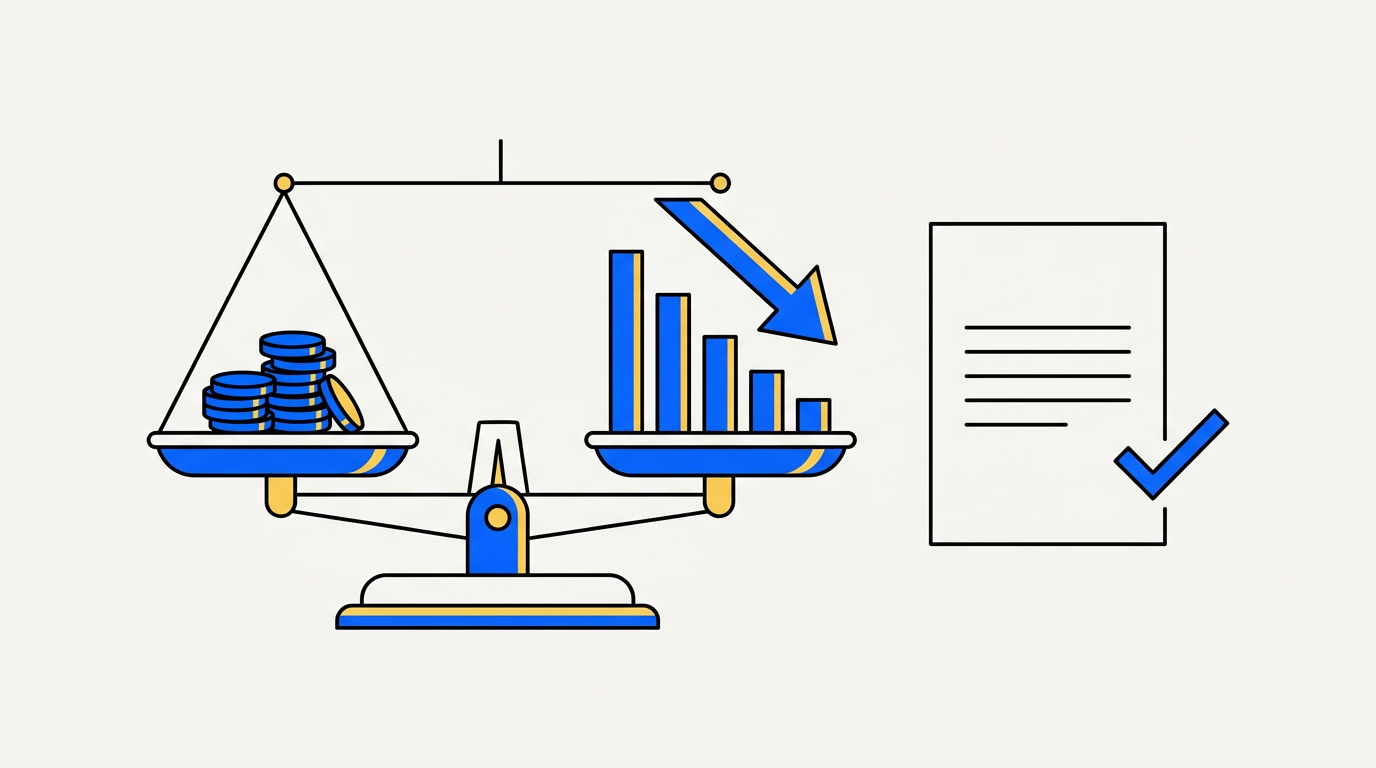
You pitched the platform. The CFO heard a cost. Pitch the 139→57 instead.
That number is not a feature. It is a measured delta — 139 days of procurement cycle time reduced to 57, at a Kuwait bank, with the same headcount. The CFO did not need to understand the tool. The CFO understood 82 days of work, retired.
Most process-improvement business cases fail before the CFO meeting. Not because the solution is weak. Because the case is structured the wrong way around.
The Price-Led Case Gets Heard Once
The moment your deck opens with platform cost, the CFO reframes the conversation as a spend decision — and spend decisions default to no.
A price-led case positions the initiative as a cost the organisation must absorb. It asks the CFO to take a risk on a future benefit that has not yet been measured. The approver has no baseline to verify the gain against. Without a baseline, there is no delta. Without a delta, there is no payback period. There is only a purchase.
This is why most automation and process-engineering proposals get deferred, renegotiated down, or approved for a "pilot" so narrow it cannot prove anything. The business case structure itself created the resistance.
The split that matters is not between good ideas and bad ideas. It is between cases that open with the cost of the tool and cases that open with the cost of the status quo.
The Kuwait Procurement Case: What a Headline Proof Looks Like
A Kuwait bank's procurement cycle ran at 139 days. After process engineering — not automation first, but Eliminate and Simplify first — it ran at 57 days.
This is a procurement engagement. The numbers are real and specific: 59% cycle-time reduction, 82 days of work retired, 106.9% efficiency improvement, same headcount. No retrenchment. No expensive infrastructure overhaul.
The CFO approval case was not built around a tool. It was built around the as-is baseline: 139 days, measured, documented, confirmed by the process owners. The delta — 82 days — became the headline. The tool was the means. The delta was the business case.
What made this case approvable was the rigour of the baseline. When the as-is cycle time is a verified number, not an estimate, the CFO is not being asked to trust a vendor projection. The CFO is looking at their own organisation's measured inefficiency.
The One-Page Business Case Template
A complete process-improvement business case fits on one page when it is structured around four numbers: baseline, delta, payback period, and cost of inaction.
The table below is the artefact. Use it as your working template. The worked example is drawn from a mid-tier bank credit operations context — a process most SG/MY ops-transformation leads will recognise immediately.
| Business Case Element | What to Measure | Worked Example: Credit Operations Review |
|---|---|---|
| Baseline (As-Is) | Current cycle time in days; headcount involved; error rate; rework hours per month | Credit review cycle: 22 working days; 6 FTEs; 18% rework rate; 40 rework hours/month |
| Delta (To-Be) | Projected cycle time after Eliminate + Simplify; projected rework reduction | Target: 11 working days; rework rate 5%; rework hours 10/month |
| Payback Period | (Total project cost) ÷ (monthly savings from delta) | Project cost: SGD 80,000. Monthly FTE savings equivalent: SGD 12,000. Payback: 6.7 months |
| Cost of Inaction | Monthly cost of current waste: rework hours × blended FTE rate, plus delay cost per application | 40 rework hours × SGD 75/hr = SGD 3,000/month rework. 11-day delay × 30 applications/month × SGD 200 opportunity cost = SGD 6,000/month. Total inaction cost: SGD 9,000/month |
The cost-of-inaction row is the one that most decks omit. It is also the row that converts a spend decision into a recovery decision. When the CFO can see that doing nothing costs SGD 9,000 per month, the SGD 80,000 project is not an expense — it is the option that stops the bleed.
"CFOs don't buy tools; they buy measured deltas. If you walk in without a baseline, you are asking the CFO to fund an idea. Walk in with a baseline and the idea becomes a recovery." — Abdulla Al-Awadi, ESSAM's founder and former Chief Strategy Officer at a Kuwait bank.
Why the Baseline Is Your Cheapest First Step
If you cannot state your as-is cycle time in days, you are not ready for the CFO meeting — you are ready for a baseline capture.
This is not a criticism. It is a sequencing observation. Most ops-transformation leads in SG/MY mid-tier banks have a clear sense of which processes are slow. Few have a number. The jump from "our credit review feels slow" to "our credit review runs at 22 days with 18% rework" is the jump that makes the business case approvable.
ESSAM captures that baseline conversationally, in a single session. No notation software. No workshop preparation. A process owner walks through what they actually do. ESSAM's conversational model records it and auto-tags waste across eight MUDA categories. It then produces a before/after audit view, SOPs, and SLA benchmarks directly from the live capture.
That audit view becomes your evidence pack. The before state is the baseline. The after state — the optimised model after Eliminate, Simplify and Standardise steps run — is the delta. The payback period follows from those two numbers and your blended FTE cost.
The E-S-S-A-M Sequence and the Measurement Gate
The Baseline step in ESSAM's 7-step AI Lean Cycle is not a preamble — it is the measurement gate that determines whether every downstream step is worth running.
The full cycle runs: Baseline, Map, Analyse waste, Optimise, Document, Deploy, Improve. The Baseline step is where cycle time, headcount, error rate, and rework hours are confirmed against actual process behaviour. Nothing downstream is speculative once the baseline is real.
The E-S-S-A-M action sequence — Eliminate, Simplify and Standardise, Automate, Migrate — begins after the waste analysis is complete. Automate is the fourth action, not the first. This is the reason the delta in the Kuwait procurement case was so large: 82 days retired before automation entered the picture. The business case gains came from removing and redesigning work, not from purchasing workflow software.
Bad and undesigned processes cost organisations roughly 30% of annual revenue. For a mid-tier bank running SGD 500 million in operating costs, that is a large number sitting in unexamined process waste. The CFO already suspects it. A baseline makes it visible — and once visible, the conversation is not about affordability, it is about priority.
Book a demo on your process. Your actual workflow. No hypothetical use case required.
Related reading: How to calculate business process cost · Process improvement ROI in banking · ESSAM features