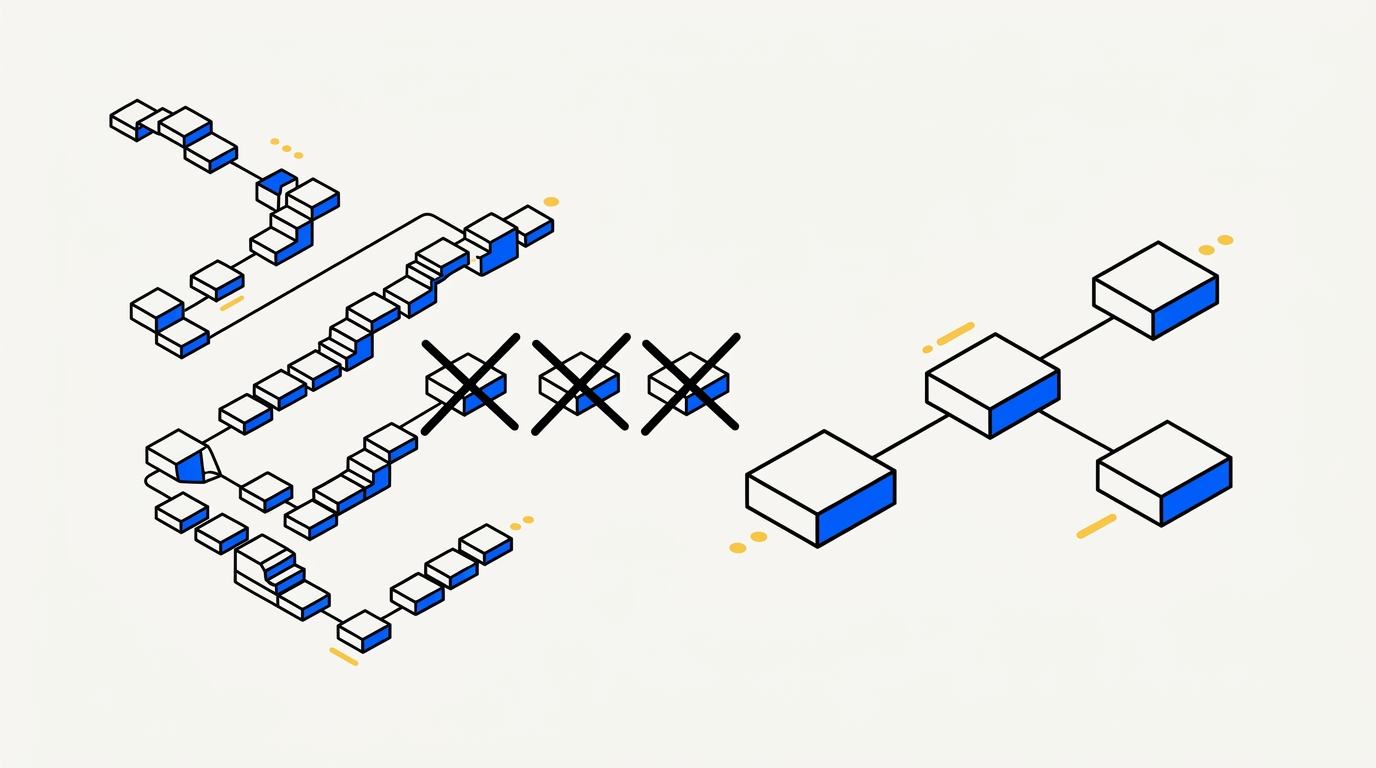
Your team just completed a process improvement project. A 34-step approval workflow is now 31 steps. Three steps removed, three months of analysis, a sign-off from the steering committee.
Eliminate would have taken it to nine.
That gap — between optimising what exists and questioning whether it should exist — is where most efficiency spend disappears without trace. Streamlining a business process does not mean making each step run faster. It means proving that most steps do not deserve to exist at all. A faster waste is still a waste.
What Streamlining Actually Requires
The word gets applied loosely. Teams use it to mean 'reduce friction.' Vendors use it to mean 'automate.' Neither definition is correct for banking operations. There, the cost of a wrong step is not just execution time. It is compliance exposure, audit trail complexity, and the salary of every person who touches that step, every day, indefinitely.
Streamlining a business process requires a prior decision: does this step earn its place? If a step captures data nobody reads downstream, that step is not slow — it is wrong. Making it faster, assigning it to a bot, or adding a dashboard to track it will not change that fact. The step should not exist.
This distinction is what separates process streamlining from process automation. Automation locks in whatever process it touches. A broken flow, automated, becomes a faster broken flow with a change-control overhead attached.
E-S-S-A-M: Why Eliminate Comes First
The E-S-S-A-M framework — Eliminate, Simplify and Standardise, Automate, Migrate — is deliberately sequenced. Eliminate is the first phase. Everything that survives it costs less to simplify, less to automate, and less to migrate.
Most process programmes skip directly to Automate. The logic is understandable. Automation is visible, it produces dashboards, and a vendor is ready to demo on Tuesday. The problem is sequencing: you are committing to running steps correctly, at scale, before confirming those steps should run at all.
Abdulla Al-Awadi, who designed E-S-S-A-M as Chief Strategy Officer at a Kuwait bank, frames it this way: 'Elimination is a quality move, not a cost-cutting move. Every step you keep is a step you are committed to running correctly, forever.'
The word 'streamline' carries the same logic. The lean root of the metaphor is reduction, not acceleration. A streamlined object has less drag because material was removed, not because the remaining material was polished.
The Kuwait Case: 139 Days to 57 Days
A Kuwait bank's procurement cycle ran 139 days in total. The team mapped every step across three departments — requisition, finance, and vendor management — and applied a disposition decision to each one.
The result: 57 days. A 59% cycle-time reduction. 82 days of work retired. A 106.9% efficiency improvement. Same headcount.
The gain did not come from faster approvals. It came from deleted steps. Duplicate document submissions. Approval gates operating in two systems simultaneously. Checks that produced data fed into fields nobody read downstream. Waiting time between handoffs where no value transferred.
Elimination came first. What remained was simplified, then standardised, then automated where the step volume justified it. This is a procurement cycle case. The method applies broadly — but the sequence is fixed regardless of process type.
The Step-Disposition Method
Every streamlining exercise starts with the same question per step: what should we do with this? Four choices only.
| Disposition | Condition | Typical share |
|---|---|---|
| Keep | Step produces value used downstream; no duplication; owner defined | ~25% of steps |
| Delete | Step produces data nobody reads; duplicate; compensating control with no live risk; approval with 98%+ pass-through rate | ~40% of steps |
| Merge | Step and an adjacent step produce the same outcome; can share one touchpoint or one owner | ~20% of steps |
| Migrate | Step belongs to a different team, system, or channel; current process owner is wrong | ~15% of steps |
The percentages are a guide. In high-compliance environments, the 'keep' share rises. In legacy banking workflows, the 'delete' share frequently exceeds 50%. What matters is that every step receives an explicit disposition before any optimisation or automation work begins.
This table is the output of Baseline and Map — the first two phases of ESSAM's 7-step AI Lean cycle. ESSAM captures processes conversationally: no notation software, no workshop preparation. The AI auto-tags waste across eight MUDA types — over-processing, waiting, unnecessary motion, duplication, and four others — as each step is described by the process owner.
The Banking Math: Information Gain per Step
Finance and compliance audiences need a number, not just a principle. Information Gain makes the deletion case calculable.
Information Gain = (Decisions the step enables) / (Effort to run the step)
Example one: a data-capture step. Four fields. Twelve minutes per transaction at current volume. The data feeds two downstream decisions. Information Gain = 2 / 12 = 0.17. If that same data is already captured at intake and copied here, the step enables zero net decisions. Information Gain = 0 / 12 = 0. Delete.
Example two: an approval gate. A senior manager signs every procurement order above SGD 5,000. Analysis shows 98% of orders in that band are approved without change or query. The gate consumes 8 minutes of senior time per order. Effective Information Gain approaches zero. This is a risk-theatre step, not a risk-management step.
Apply this calculation to the Kuwait procurement cycle and the result becomes visible: most of the 82 days removed were steps with Information Gain near zero. Fast to run, useless in output. Elimination was the right answer; optimisation would have been expensive maintenance of the wrong things.
This is not an argument against approval gates. It is an argument for calculating whether each gate earns its cost. Most have not been reviewed since the process was designed.
Running a Streamlined Process Design in One Session
ESSAM runs the full step-disposition analysis within a single working session. The process owner describes their current workflow conversationally. ESSAM maps each step, auto-tags waste type, and calculates Information Gain per step where data is available. It then generates a before/after audit view, including a populated disposition table ready for review.
After Eliminate, the remaining steps go through Simplify and Standardise before any automation is considered. SOPs, policies, SLAs, and RACI assignments are generated from the live process model. ESSAM runs an FMEA before go-live to surface failure modes the original design never anticipated.
Deployment, in Singapore and Malaysia, runs over WhatsApp. Near-universal adoption. No new application to install. No training cycle. The approved standard reaches every person who touches the process directly, on the channel they already use.
If you are carrying an efficiency mandate and reaching for automation tooling first — stop. Classify every step. Delete what should not exist. That is what streamlining a business process actually means, and that is where the real efficiency number lives.
Book a demo on your process. Your actual workflow. No hypothetical use case required.
Related reading: What Is an AI Process Engineer? · Seven Types of Process Waste in Banking · How to Calculate Business Process Cost