The market moved 30 pips. Your settlement failed for three days. Those are different problems.
In most post-mortems, treasury teams reach for the same two explanations: the market was volatile, or the system did not keep up. Both are technically defensible. Neither points to the fix.
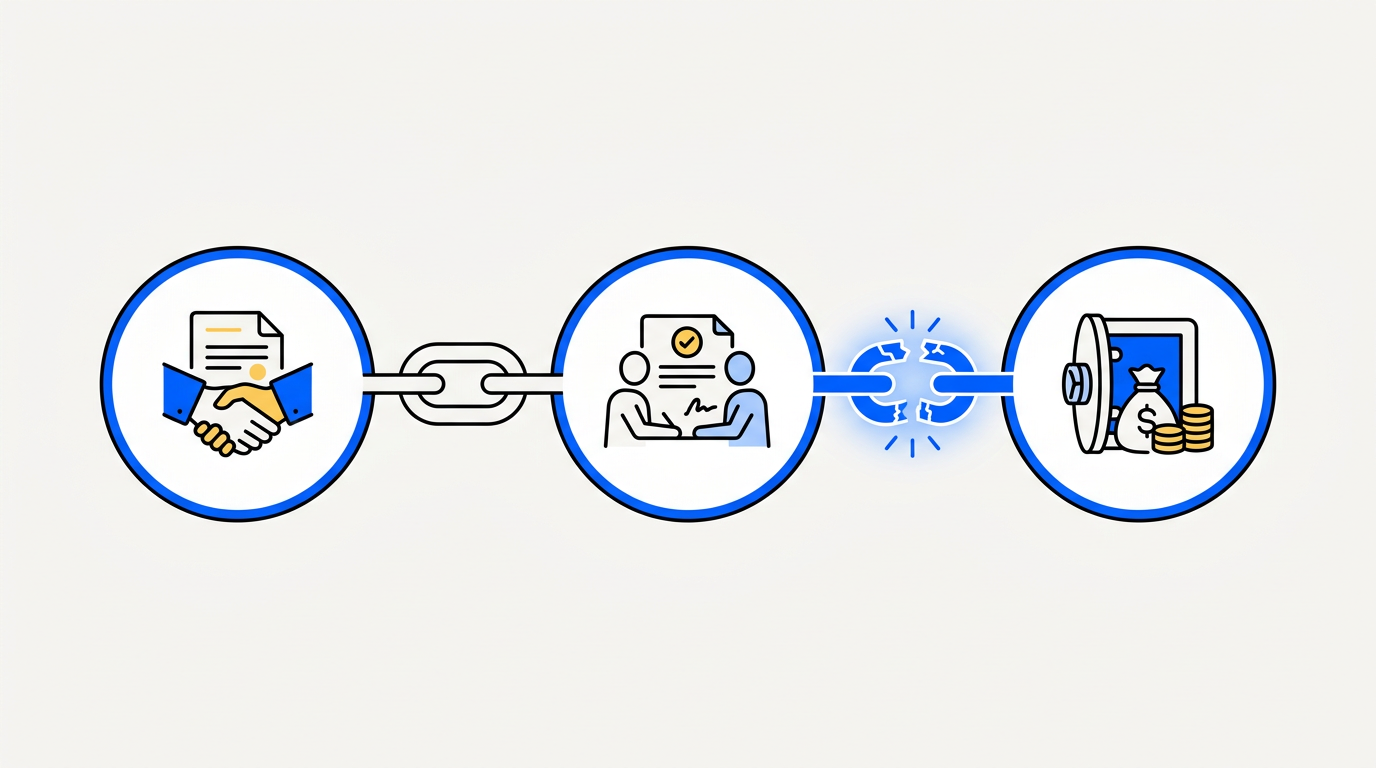
The real variable is the chain from deal execution to confirmation to settlement, and who owns each handoff. When that chain is not mapped, every failure looks like an external event.
Why the Systems Argument Persists
Treasury system vendors are well-funded and well-represented in the room after a settlement failure. Consultants arrive with architecture diagrams. Both conversations focus on the infrastructure layer.
Neither conversation typically produces a handoff-level map of the deal-to-settle chain.
The system processes the instruction it receives. If the instruction arrives late, contains a field error, or carries a counterparty mismatch, the system rejects or delays. The rejection is correct. The process that produced the bad instruction is the problem.
Blaming the system is organisational comfort. It keeps the budget conversation on infrastructure, where spend is visible and defensible. It also means the handoff chain never gets examined — and next quarter's settlement fail count looks similar to this quarter's.
The Deal to Confirm to Settle Handoff Chain
Every FX and money-market settlement failure traces to one or more breaks in a predictable sequence. Below is a baseline handoff inventory for a standard treasury operation.
| Handoff | From | To | Common failure mode |
|---|---|---|---|
| Deal capture | Front-office trader | Middle-office confirmations team | Late entry, incorrect rate or value date, missing counterparty reference |
| Confirmation dispatch | Middle-office | Counterparty back-office | Delayed dispatch, unmatched field formatting |
| Confirmation matching | Counterparty | Matching engine | Field discrepancy, reference mismatch, missed cut-off deadline |
| Nostro reconciliation | Back-office | Correspondent bank | Timing gap between expected and actual cash posting |
| Fail management | Back-office | Front-office or treasury ops | No defined escalation owner; fail persists overnight |
| STP exception handling | Straight-through processing gate | Manual repair queue | No documented repair SLA; queue grows until end of day |
Not every bank operates all six handoffs in this exact form. Most have variations. Almost none have this inventory mapped, version-controlled, and owned.
When STP breaks, the question 'which handoff failed first?' should be answerable in under five minutes. In most banks, it takes a day and three meetings.
Organisational Debt, Priced as Market Risk
Consider a treasury back-office team at a mid-sized bank facing a settlement fail that stretched over four days. The rate had moved. The counterparty was unresponsive. The internal story was 'bad market conditions.'
An investigation of the handoff chain found a confirmation dispatch delayed by 18 hours. The confirmations team was waiting for a trader sign-off that had never been formally required. The handoff had no owner, no SLA, and no escalation path.
That is an illustrative scenario. The mechanics appear regularly in treasury operations.
Abdulla Al-Awadi, former Chief Strategy Officer at a Kuwait bank and founder of ESSAM, frames it directly: 'Settlement failure is organisational debt priced as market risk.' The market provides the context. The handoff failure is the cause.
This distinction matters for regulators. It matters for ops budgets. It matters for every post-mortem that ends with a systems recommendation.
What Process Engineering Adds
The ESSAM methodology runs four phases in deliberate sequence: Eliminate, Simplify and Standardise, Automate, Migrate. Automation is the fourth phase, not the first.
For treasury operations, the sequence works as follows:
- Eliminate: Remove approval gates and confirmation steps that add no control value. Many survive because someone required them once and no one has questioned them since.
- Simplify and Standardise: Define the confirmation dispatch window. Set a repair SLA for STP exceptions. Assign ownership to each handoff in the inventory above.
- Automate: Route clean confirmations through STP. Build exception alerts for the handoffs most likely to fail. Automation performs on a designed process, not an inherited one.
- Migrate: Deploy approved SOPs, SLAs, and RACI assignments to where treasury staff actually work.
ESSAM captures current-state treasury workflows conversationally, in a single session with deal, confirm, and settle teams in the room. It auto-tags waste against eight MUDA categories and generates a before-and-after audit view. It runs a failure-mode analysis before any redesigned process goes live. Standards deploy over WhatsApp, which back-office staff in Singapore and Malaysia already use, with no additional training required.
The Analogy Worth Naming
A Kuwait bank cut a procurement cycle from 139 days to 57 days, a 59% reduction, by eliminating and simplifying before automating anything. That was procurement, not treasury. The methodology transfers.
The gain came from handoffs with no owner, approvals that duplicated checks already done upstream, and steps that survived because no one had mapped the chain. The same audit finds the same patterns in treasury operations across Singapore and Malaysia.
The point is not that treasury operations resemble procurement. The point is that unclaimed handoffs carry cost in every operations function — and that cost stays invisible until the chain is mapped and owned.
The 7-step ESSAM AI Lean cycle (Baseline, Map, Analyse waste, Optimise, Document, Deploy, Improve) produces that map: a handoff chain with waste tagged and ownership assigned at every node.
Starting the Audit
A settlement failure audit does not require a systems integrator or a multi-week engagement. It requires a session with the people who own each handoff in the inventory above, and a methodology that records the current state accurately enough to act on.
ESSAM runs that session. The before-and-after audit view is available before the engagement closes.
If your settlement fail count is growing and your post-mortems keep concluding 'market conditions,' the handoff chain is worth examining. Book a demo on your process. Your actual workflow. No hypothetical use case required.
Related reading: Cross-border payments process · Bank reconciliation process improvement · ESSAM features