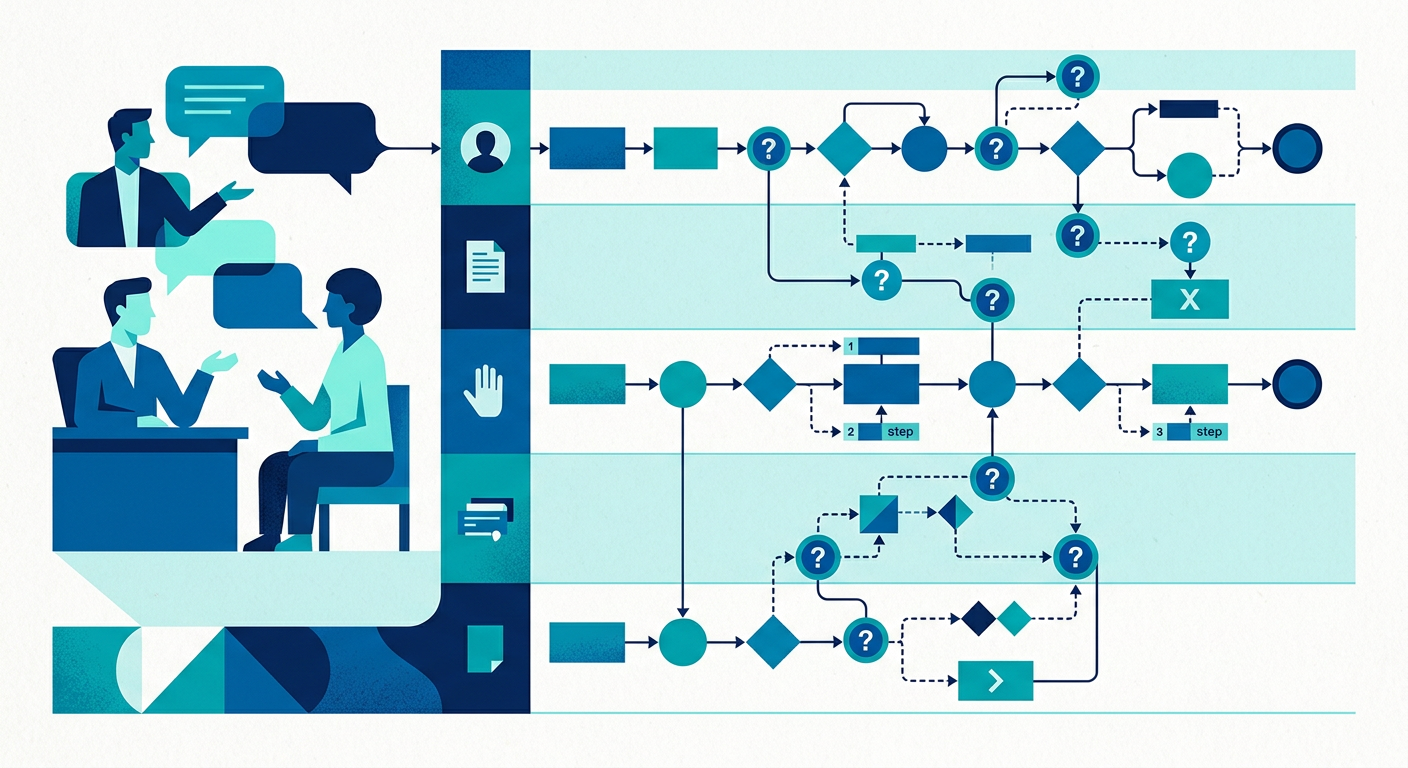
Twelve questions, asked in a fixed order about the last real piece of work, are enough to map most operational processes in one sitting. They work because they ask for artefacts and interruptions, never for steps.
This post sets out the full protocol: the twelve questions, a follow-up probe for each, the failure each one is built to surface, a printable one-page capture sheet, and a five-minute step that turns answers into map rows.
Why "describe your process" never works
Ask an expert to describe their process and they will describe the version they wish they ran.
This is not obstruction. Expertise compresses. After years in a role, the person narrates the intended path and silently skips the exceptions they handle without thinking. A settlements supervisor does not mention the mismatched account number she fixes by phone every Tuesday. To her it is not a step. It is just Tuesday.
So a question like "walk me through your process" guarantees a description of the ideal process. That is the happy path, and it is the path already written in the Standard Operating Procedure (SOP).
The fix is to change what you ask for:
- What did you receive?
- What did you send?
- What made you stop?
- What did you do when it was wrong?
Artefacts are things a person can point to: an email, a form, a screen, a spreadsheet, a message. Interruptions are the moments the work stopped or went sideways. Neither can be skipped as obvious, because the person is reading them off a real item, not reciting a policy.
Process capture fails at the question, not at the tool. Fix the question first.
How to run the sitting
The protocol needs very little set-up. Keep to these rules and the twelve questions do the rest.
- One person, one process, one sitting. Aim for 45 to 60 minutes. Do not invite a committee; people describe the ideal process in front of their manager.
- Anchor on one real instance. Ask the person to pick the last item they finished, not a typical one. "Typical" invites the happy path. "Last" invites the truth.
- Have the artefacts open. The mailbox, the shared drive, the system screen. Ask the person to share or read from them.
- Ask in order. Each answer seeds the next question. Question 3 is easier to answer because question 2 already named what arrived.
- Write what you hear, not what you expect. Do not tidy it into a flowchart during the session.
- Never answer for them. If they pause, wait. The pause is where the exception lives.
Where you can, run the sitting at the person's desk. That is the same logic behind a Gemba walk: the work explains itself when you stand next to it.
The twelve questions, in order
Each question has three parts: the ask, a follow-up probe for when the first answer is thin, and the failure mode the question exists to surface.
1. The last real item
Ask: "Think of the last one you finished. What was it, and how did it reach you?"
Probe: "Can you show me where it arrived?"
Surfaces: The undefined trigger. Many processes start from a mix of email, calls, and walk-ups that nobody has ever counted. Without a real instance, everything after this question becomes theory.
2. What arrived with it
Ask: "What came with it? Documents, data, an instruction?"
Probe: "What was missing, and who did you ask?"
Surfaces: Incomplete inputs and the chasing loop. The probe usually exposes an informal rework step: a person who spends part of every day asking colleagues for what the form should have contained.
3. The first thing you opened
Ask: "What was the first thing you opened or touched to start on it?"
Probe: "Which system, file, or message was that? Is it the official one?"
Surfaces: Shadow tools. Personal trackers, private spreadsheets, and saved templates often carry more of the real process than the approved system does.
4. What you checked
Ask: "Before you moved it on, what did you check?"
Probe: "How did you know it was fine? Who taught you that check?"
Surfaces: Tacit controls. These are checks that exist only in one person's head. They are real risk mitigation, and they vanish the day that person moves teams.
5. What you sent on
Ask: "What did you pass to the next person, and in what form?"
Probe: "How do you know they received it?"
Surfaces: Invisible handoffs. If the answer is "I assume so", you have found a gap where work can sit unnoticed.
6. Where it waited
Ask: "When you were not touching it, where did it sit?"
Probe: "How long did it sit, last time?"
Surfaces: Queue time. Most elapsed time in a process is waiting, not working, and nobody records it because no one is doing anything during it. Ask for the actual dates on the last item.
7. What you do when it is wrong
Ask: "What do you do when it is wrong?"
Probe: "When did that last happen? Walk me through that one."
Surfaces: The exception paths. This is the question that usually doubles the step count. Rework loops, corrections, and returns to sender are invisible in a happy-path description and substantial in a real one.
8. What makes you stop
Ask: "What makes you stop and wait for someone else, or go and find someone?"
Probe: "Who do you call, and what do they usually say?"
Surfaces: Interruptions and escalations. The people you call are the real decision-makers, and they rarely appear on the org chart for this process.
9. Who has to say yes
Ask: "Who has to approve it, and what do they actually look at?"
Probe: "What happens when they are away?"
Surfaces: Approval theatre and delegation workarounds. If the approver signs without opening the attachment, or someone else uses their login, the control is a formality. That belongs on the map.
10. What is not in the SOP
Ask: "What do you do that a new joiner would not know from the written procedure?"
Probe: "Who showed you? Is it written anywhere?"
Surfaces: SOP drift. The gap between the written procedure and the working one is the whole reason the capture is needed. Question 10 names it.
11. What you leave behind
Ask: "What record do you leave that someone else could review later?"
Probe: "Where is it stored, and could you find it in a minute?"
Surfaces: Audit gaps. In regulated settings in Singapore and Malaysia, the question is whether evidence exists and can be retrieved. Under Monetary Authority of Singapore or Bank Negara Malaysia supervision, you will want that answer before an examiner asks.
12. How you know it is finished
Ask: "How do you know it is done? What would make it come back?"
Probe: "Which step would you drop first if nobody noticed?"
Surfaces: The missing definition of done, and the first Eliminate candidate. The probe is deliberate. People know exactly which of their steps adds nothing. They rarely say so until asked directly.
What to do when the answer is "it depends"
"It depends" is the most valuable answer in the sitting. It means there is a branch the person handles without thinking.
Do not accept it and move on. Ask, "What did it depend on, the last time?" Then ask for the other time it went the other way. Write both as separate branches, each with its condition.
Three "it depends" answers in a sitting is normal. Six means the process has no standard at all, which is a finding in itself.
A worked example (illustrative)
Consider a business analyst who runs the twelve questions with a settlements supervisor. The analyst picks the supervisor's last completed item, a trade confirmation that failed to match. The sitting takes 50 minutes.
The department's SOP lists eleven steps. By question 7, the supervisor has described a call to the counterparty's operations desk, a manual correction, and a second review by a colleague. By question 10, she mentions a personal tracker she keeps because the official system does not show ageing items.
At the end, the analyst's map has nine steps the SOP does not contain. None was hidden on purpose. Each was something the supervisor did so routinely that she had never counted it.
This is a constructed example to show the shape of the result, not a client account. The point is the mechanism. She was no more candid than usual. The questions simply had her pointing at a real item instead of reciting the procedure.
The one-page capture sheet
Print this page, or copy it into a document. Write the person's name, the process, the date, and the single instance you anchored on at the top. Then work down the table.
Process: ______________ Person and role: ______________ Date: ______________ Instance (the last one): ______________
| # | Ask for | A good answer sounds like | If the answer is "it depends" |
|---|---|---|---|
| 1 | The last real item and how it arrived | A specific item, a date, a named channel | Ask for the last two items. Note the difference in arrival |
| 2 | What came with it | A list of named documents or fields | Ask what was missing last time. Record the chase |
| 3 | The first thing opened | A named system, file, or message | Ask which one when it is urgent. Record both |
| 4 | What was checked | Specific fields or figures and a reason | Ask who taught the check. Mark it as tacit |
| 5 | What was passed on | A named recipient and a named form | Ask how receipt is known. Mark unconfirmed handoffs |
| 6 | Where it waited | A place and a duration in hours or days | Ask for the real dates on the last item |
| 7 | What happens when it is wrong | A recent specific case and what was done | Ask for the last time. Record as an exception branch |
| 8 | What makes you stop | A named person or event, with the usual reply | Ask who actually decides. Record the real owner |
| 9 | Who approves and what they see | A named role and the item they open | Ask what happens when absent. Record the delegate |
| 10 | What is not in the SOP | A named habit, who taught it, no written copy | Ask if a new joiner would find it. Flag as drift |
| 11 | What record is left | A named location and a retrieval time | Ask who else could find it. Flag any audit gap |
| 12 | How it is known to be done | A visible closing event and a reopen reason | Ask what reopened it last. Ask which step to drop first |
Leave two blank lines under the table for "things I heard that did not fit a question". Those lines are often where the best finding sits.
The five-minute normalisation step
Raw answers are not yet a map. Spend five minutes straight after the sitting, while the session is fresh.
- Minute one: number the answers. Tag every sentence with the question it came from (Q1 to Q12). You will need the trail later when someone asks, "where did this step come from?"
- Minute two: write one row per artefact or interruption. Each row has an actor, an input artefact, an output artefact, the system used, and the wait time. A step is whatever happens between an artefact arriving and an artefact leaving.
- Minute three: split every "it depends". Turn each one into a branch with its stated condition.
- Minute four: mark confidence. Label each row as seen (the person showed the artefact), told (described only), or assumed. Anything assumed goes back to the person for confirmation.
- Minute five: flag the gaps. Mark each row that is not in the current SOP. Mark each unrecorded wait. Mark each check with no owner.
The output is a table of rows, one per step, with a source question next to each. That table is the as-is baseline. It is also the input to the comparison described in as-is and to-be process mapping.
Where this fits in the ESSAM method
In the 7-step AI Lean Cycle (Baseline, Map, Analyse waste, Optimise, Document, Deploy, Improve), these twelve answers are the Baseline. They are the evidence the later steps stand on.
Once the rows exist, each can be classified under the E-S-S-A-M framework: Eliminate, Simplify and Standardise, Automate, Migrate. Automate is the fourth action on purpose. You design before you automate, and you cannot design what you have not captured accurately.
The one real outcome ESSAM can cite shows why the order matters. A Kuwait bank's procurement cycle fell from 139 days to 57 days, a 59% reduction, with the same headcount. It came after Eliminate and Simplify, before any automation. This is a procurement cycle only, and it is a real case, not a general claim for other functions.
Clean capture also feeds the Document phase. Every row with a source question becomes a line in a work instruction, which is how an AI process engineer turns a conversation into SOP generation without losing the exceptions.
Do the twelve questions replace the platform?
No, and it would be wrong to say so.
The twelve questions are a method. Anyone can run them with a notepad. Their limit is what happens afterwards: someone has to normalise the rows, draw the map, classify the waste, write the work instructions, and keep them current.
Single-session capture in ESSAM is the product proof that one sitting is enough. ESSAM runs a guided conversation that asks for the same artefacts and interruptions, then builds the map and classification from the answers. Work instructions are delivered over WhatsApp, which is the channel Singapore and Malaysia teams already use. You can see the full set in ESSAM features.
If you are not ready for a platform, run the protocol by hand first. You will find out quickly whether your process is what your SOP says it is.
Closing
Process capture usually stalls on a question that invites the ideal version, not on the tool. Ask for the last item, the artefacts, the interruptions, and what went wrong. Twelve of those, in order, take about an hour and give you a map you can trust.
Print the sheet, pick one process this week, and run it. Then compare the result with the SOP, and see how many steps the document never mentioned. To see single-session capture on your own process, visit apac.essam.ai