Bad processes cost organizations 30% of annual revenue. That number comes up consistently across industries — manufacturing, financial services, healthcare, logistics. The waste is real. What's missing is a structured method to find it, redesign it, and document the fix before the next audit cycle arrives.
The E-S-S-A-M framework is that method.
Used by 10,000+ Lean Six Sigma professionals through Essam.ai, E-S-S-A-M gives every activity in a process exactly the treatment it needs — no more, no less. It is the Improve phase of DMAIC executed with methodology precision and the speed of agentic AI.
What Is E-S-S-A-M?
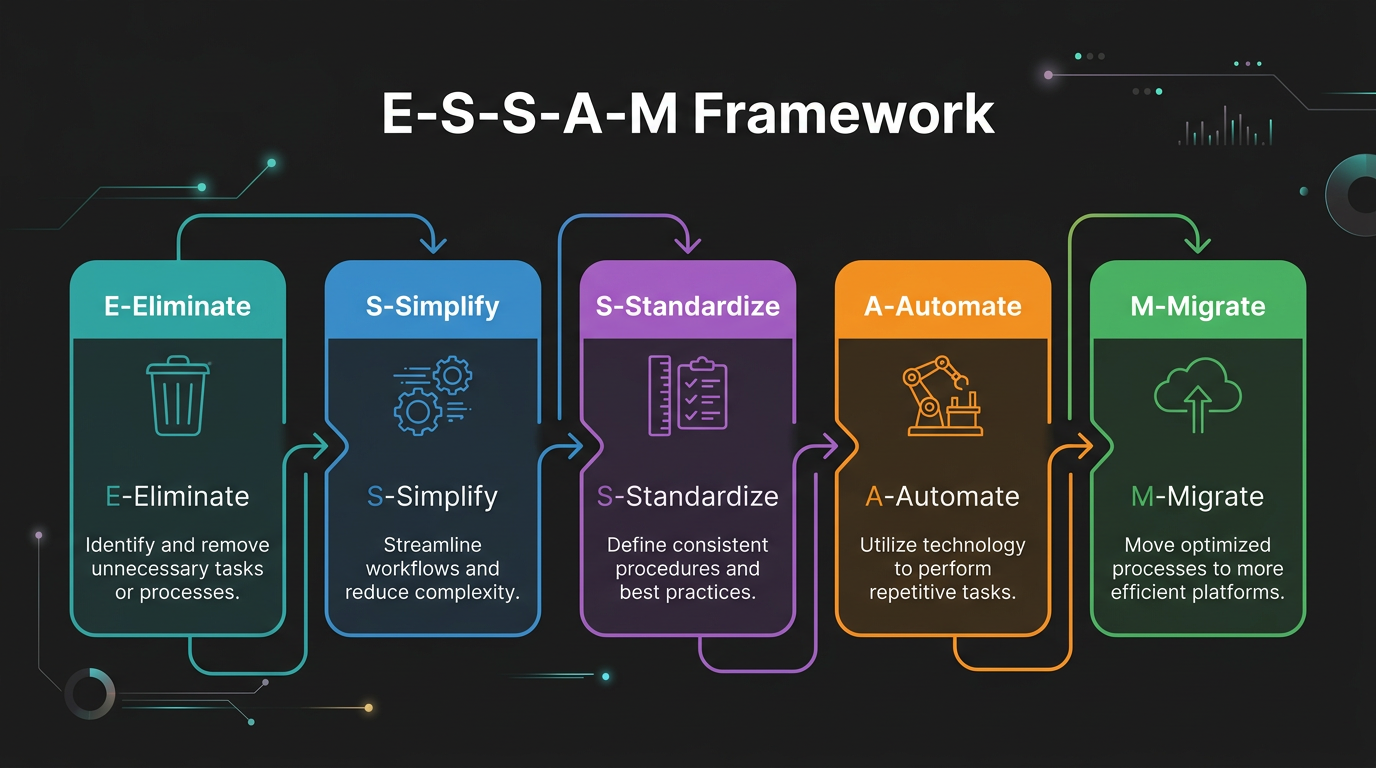
E-S-S-A-M stands for five waste treatment options, applied in sequence:
- E — Eliminate unnecessary activities
- S — Simplify and S — Standardize what remains
- A — Automate what can run without human intervention
- M — Migrate low-value work to lower-cost resources
Each activity in a mapped process receives exactly one of these five treatments. The result is a redesigned workflow with no ambiguity about what should happen, who should do it, and how.
How Each Step Works
E — Eliminate
The first question for every activity: does this need to exist?
Lean Six Sigma practitioners know that the most expensive process step is the one that adds no value. Essam.ai identifies these during the baseline analysis phase — surfacing redundant approvals, duplicate data entry, and hand-off loops that accumulated over years of incremental change.
Outcome: Fewer steps. Faster cycle time. Lower error surface.
S — Simplify and Standardize
Activities that survive elimination go through simplification first. Complexity is reduced: decision points are clarified, instructions are made explicit, exceptions are documented rather than improvised.
Then standardization: the simplified process is codified as the default method. Every instance of this process runs the same way.
Outcome: Consistent execution. Reduced variation. Measurable baselines.
A — Automate
Standardized, repeatable activities are the only safe candidates for automation. Automating a broken or variable process amplifies the defect. E-S-S-A-M ensures standardization precedes automation — always.
Essam.ai identifies automation opportunities within the mapped workflow and flags them for integration with existing systems.
Outcome: Reduced manual workload. Faster throughput. Scalable capacity.
M — Migrate
Some activities belong in the process but not with the current resource. Migration reassigns work to lower-cost personnel, offshore teams, or shared services — wherever the cost-to-competency match is better.
Outcome: Reduced labor cost on routine tasks. Senior resources freed for higher-value analysis.
How E-S-S-A-M Maps to DMAIC
DMAIC defines five phases: Define, Measure, Analyze, Improve, Control. E-S-S-A-M is the operational engine inside the Improve phase.
Where DMAIC asks "what should change," E-S-S-A-M answers "how to change each activity, specifically."
| DMAIC Phase | E-S-S-A-M Role |
|---|---|
| Define | Scope confirmed; process selected |
| Measure | Baseline established through Essam.ai conversation interface |
| Analyze | Waste identified; activity list mapped |
| Improve | E-S-S-A-M applied to each activity |
| Control | SOP and stakeholder presentation generated; deployed via WhatsApp |
Lean Six Sigma Black Belts using Essam.ai have reported compressing the Measure-to-Improve cycle from weeks to a single session. The platform handles process mapping, waste identification, and E-S-S-A-M treatment recommendations through a chat-based interface — no consultants, no offline documentation sprints.
The Outputs You Get
Every E-S-S-A-M redesign session in Essam.ai produces:
- Audit-ready Standard Operating Procedure (SOP): Deployable on the same day
- Stakeholder presentation: Executive-ready, formatted for board or C-suite review
- Before/after process comparison: Quantified improvement against the baseline
- RACI matrix: Roles and responsibilities documented at the activity level
- Deployment via WhatsApp: SOPs pushed directly to frontline teams
This is the Documentation That Ships principle in practice: no post-analysis work, no consulting write-up phase.
E-S-S-A-M Inside the 7-Step AI Lean Transformation Cycle
E-S-S-A-M does not operate in isolation. It is embedded at Step 3 of Essam.ai's 7-step AI Lean Transformation Cycle:
- Baseline current process
- Analyze for waste
- Optimize using E-S-S-A-M
- Document and approve the redesigned process
- Deploy via WhatsApp to frontline teams
- Collect feedback
- Repeat continuously
The cycle is designed for ongoing improvement, not one-time projects. E-S-S-A-M is the method that ensures each iteration produces a defensible, documented change — not an improvised adjustment.
Ready to Apply E-S-S-A-M to Your Processes?
Bad processes cost 30% of revenue. The E-S-S-A-M framework gives your team a structured path to reclaim it — and Essam.ai delivers that framework through a conversational AI interface that produces audit-ready SOPs in minutes.