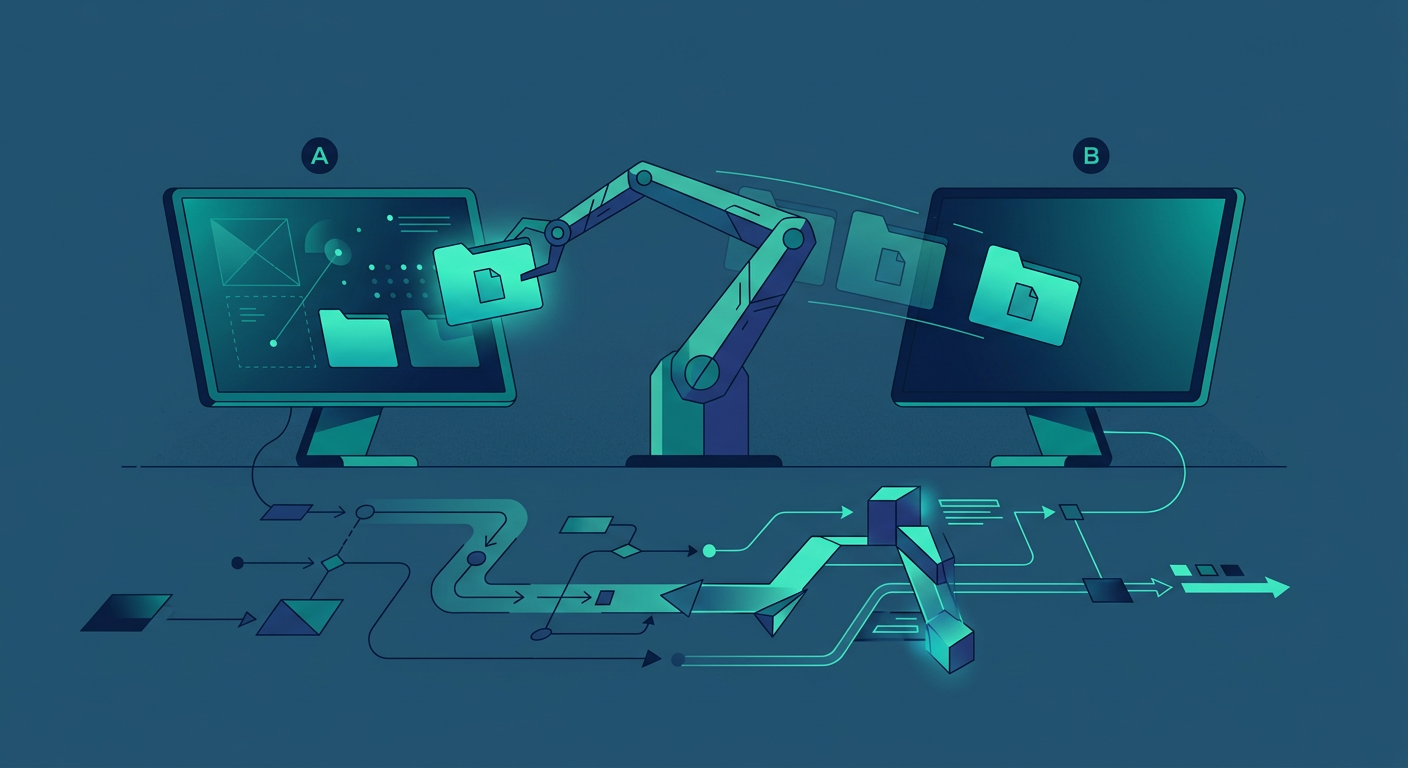
Robotic process automation (RPA) is software that copies the steps a person takes on a screen, so a rule-based task runs without that person. Whatever the category is called this quarter, RPA does four things to a process: it copies, routes, checks, and logs.
That one sentence is the definition worth keeping. Names change every few years. The work underneath does not.
If you run operations or automation in a Singapore or Malaysian bank, or in a shared-services centre, you probably have bots in production already. You are also being sold "agentic" replacements for work your team cannot yet describe in one page. This post gives you a definition you can test, the evidence that the label keeps drifting, and an audit checklist you can run on any bot this week.
What does RPA mean?
RPA stands for robotic process automation. The "robot" is not a machine. It is a script that operates software the way a clerk would: it opens a screen, reads a field, types into another field, and clicks a button.
The robotic process automation definition, in plain terms: software that imitates a person's actions in existing applications, following fixed rules, without changing those applications.
- It needs a process that is stable, repeated, and described in enough detail for a script to follow.
- It works at the screen or interface level, so it does not need access to a system's code or database.
- It does not decide what the process should be.
Most definitions skip that last point. RPA executes a process. It has no view on whether the process is any good.
Plenty of people still ask. A keyword pull on 12 October 2026 showed about 720 monthly searches for "rpa meaning", about 590 for "rpa process automation", and about 260 for "what is rpa".
Attended and unattended bots
Attended RPA runs on a person's desktop and helps with a task, for example filling in a form after they trigger it. Unattended RPA runs on a server, on a schedule or a trigger, with no person present. Both do the same four things. The difference is who is watching.
Why does the RPA name keep changing?
The label has moved several times, and the work it describes has not. Vendor material has used roughly these names, in roughly this order:
- Robotic process automation. The original term. Bots copy screen actions.
- Intelligent automation. Bots plus document reading and basic machine learning.
- Hyperautomation. A bigger umbrella that bundles bots, process discovery, and analytics.
- Agentic automation. Software that chooses its own next step toward a goal.
- Computer use. Models that look at a screen and operate it.
Read that list as an operator and a pattern appears. Item 5 reads a screen and operates it. That is item 1, with a different engine. The screens did not change. The invoice is different.
What the market is saying right now
Three public signals from early October 2026 show the category is anxious about its own name.
- On 6 October 2026, a post on X reported that an enterprise software vendor had announced its intent to acquire an AI company focused on enterprise RPA.
- On 8 October 2026, another X post described "computer use" as a new name for RPA.
- Also on 8 October 2026, a separate X post asked whether universal AI agents will replace RPA suites.
None of these posts proves anything alone. Together they show buyers and vendors asking one question: is the thing I own about to be replaced, or just renamed?
A rename tells you about the vendor's roadmap. It tells you nothing about what your bot does at 2 a.m. when a field comes back blank.
The four things RPA actually does
Strip the label and look at the work. Every RPA bot, in every bank and shared-services centre, does some mix of four things. You can check each one against a real process.
| Action | What the bot does | Example in a bank back office | What breaks it |
|---|---|---|---|
| Copy | Moves data from one screen or file to another | Keying an approved vendor record from an email into a payables screen | A field moves, renames, or becomes optional |
| Route | Sends the item to the next person or system | Passing a flagged invoice to a reviewer queue | The approver changes, or a new approval tier appears |
| Check | Applies a fixed rule and pass or fail outcome | Matching an invoice total to a purchase order within a set tolerance | The rule changes, or the exception is not in the script |
| Log | Writes down what happened | Recording the action and timestamp in a tracker for audit | The log format no longer matches what auditors ask for |
Copy
Copy is the base action. A bot reads from one place and writes to another. Copying between systems that do not talk to each other is slow and error-prone for people, so this is where early projects found their time savings.
Route
Route is the handoff. The bot decides which queue, person, or system gets the work next. It looks small, but it carries hidden policy, such as who may approve what.
Check
Check is where the rules live. The bot compares, validates, and sorts items into "fine" and "not fine". Every check is a decision someone made once and wrote into a script. When the decision changes, the bot keeps applying the old one.
Log
Log is the audit trail. In a bank under Monetary Authority of Singapore or Bank Negara Malaysia supervision, a log that matches how the process really runs is part of the control environment. A log that records the old process is a quiet liability.
Notice what is missing from the four. There is no "decide what the process should be" and no "notice the process has changed". Those are human jobs, and they are the ones that decide whether an RPA estate ages well.
RPA vs AI agents: what is actually different?
Here is a plain answer to the question behind most searches for "rpa vs ai agents".
| Rule-based RPA | AI agent or computer-use model | |
|---|---|---|
| How it picks the next step | Fixed script | Model chooses from context |
| Handles a changed screen | Usually fails or stops | Often adapts, sometimes wrongly |
| Predictability | High | Lower, depends on guardrails |
| Audit trail | Clear, step by step | Needs deliberate design |
| Cost of a wrong action | Usually a stopped job | Can be a confident wrong action |
An AI agent is more flexible at the action layer. That is a real gain. But flexibility does not answer the question the definition asks: what is the work, and is it the right work?
An agent pointed at a badly designed process will run the bad design more adaptively. It copies, routes, checks, and logs, with fewer error messages. If the process contains waste, the waste now runs on better software.
This is why the useful comparison is not bot against agent. It is process against process. Which steps should exist at all?
A constructed example: the exception queue was the process
The following is an illustrative scenario, not a client account.
Picture a shared-services team in a regional bank. It runs 40 bots across payables, onboarding checks, and reconciliations. Each month a few bots stop, and a developer fixes them.
A vendor offers an "agentic" layer that sits over the estate and promises to adapt when screens change. The team buys it. The pilot goes well on the happy path.
Then someone exports the exception queue to size the licence. The queue is large, and it is not random. The same eight or nine exception types account for most of it. They are handled by two senior staff, who fix each case from memory and a private spreadsheet.
The team realises something uncomfortable. The bots handle the easy cases, and the exception handling is the real process. Nobody has ever written it down. The new layer cannot adapt to a process nobody has described.
The scenario is constructed, but the pattern is a common one. When a team replaces a bot estate, the estate is often not the problem. The undocumented work around it is.
Audit: what is your RPA actually doing?
Print this part. It turns the four actions into a review you can run on each bot, with the person who built it and the person who owns the process in the room.
Answer these questions in writing. Where the answer is "I don't know", that is the finding.
Part 1: steps copied
- List every system the bot reads from and writes to.
- For each copy step, name the source of truth. Which system wins if two values disagree?
- Mark any step where the bot copies data that nobody downstream uses.
- Mark any step that copies data a person later retypes anyway.
Part 2: exceptions handled
- Count the exception types the script handles by name.
- Export the last 90 days of items the bot rejected, skipped, or sent to a person.
- Group those items. How many distinct causes are there?
- Record who resolves each cause, and how. Is the method written down?
- Note which exceptions are fixed by editing data, and which by overriding a rule.
Part 3: change points
- List every rule the bot checks, with the date it was last confirmed as still correct.
- List every screen, field, or file format the bot depends on.
- Identify which upstream owner can change each of those without telling you.
- Check whether any policy, regulation, or e-invoicing requirement affects the process, such as InvoiceNow, Peppol, or MyInvois in Malaysia, and whether the script reflects its current form.
Part 4: break owners
- Name the person who is alerted when the bot stops.
- Name the person who decides whether to fix the bot or fix the process.
- Record how long the last three breaks took to detect and to repair.
- Confirm that the log still matches how the process actually runs today.
How to score it
Give each part a simple rating for each bot.
| Rating | Meaning |
|---|---|
| Green | Answers are written down, current, and owned by a named person |
| Amber | Answers exist but only in someone's head or an old document |
| Red | Nobody can answer, or the answer is different depending on who you ask |
Then read the pattern across your estate:
- Mostly red in Part 2 means the exception queue is your real process. Document it before you automate or replace anything.
- Mostly red in Part 3 means your bots depend on assumptions nobody monitors. Expect breaks, and assign change-point owners.
- Mostly red in Part 4 means the cost of a break is unknown. Fix ownership first.
- Mostly green means the estate is healthy. A replacement may still make sense, and you can now write the requirement.
A bot that scores green in all four parts can be defined on one page: what it copies, routes, checks, and logs, who owns it, and what happens when it changes.
Where does RPA belong in the E-S-S-A-M framework?
E-S-S-A-M stands for Eliminate, Simplify and Standardise, Automate, and Migrate. Automate is the fourth action on purpose. You design before you automate.
RPA lives in that fourth action. Each step faces the questions in order:
- Eliminate: should this step exist at all?
- Simplify and standardise: can it be done one way, with fewer handoffs?
- Automate: does a bot, script, or agent belong here?
- Migrate: should the step move to a better system or channel?
Teams that skip to the automation question buy tools to run steps the first two would have removed. The bots then preserve the waste.
What the one real case shows
The one real client outcome comes from a single function, procurement. A bank in Kuwait cut its procurement cycle from 139 days to 57 days, a 59 percent reduction. That retired 82 days of work with the same headcount.
The gain came from Eliminate and Simplify, before any automation. It is a procurement cycle only, so do not read it as a claim about any other function. It does show the order of operations: redesign first, then decide what to automate.
For a bot estate, the audit above comes before any decision to replace, extend, or retire a bot. For the comparison with newer approaches, read AI process automation vs RPA in banking. For how RPA sits among adjacent categories, see the DPA, RPA, BPM and AI category map. For the banking detail, see RPA in banking process engineering.
Common questions about RPA
Is RPA artificial intelligence?
Not by itself. Classic RPA follows fixed rules and does not learn. It is often combined with AI components, such as document reading, but the bot's core action is still scripted.
Does RPA replace people?
It replaces keystrokes, not judgement. The work that remains for people is exception handling, rule changes, and process ownership. Those are the parts the audit above measures.
What happens when the process an RPA bot copied changes?
The bot keeps doing the old process until it errors out or, worse, completes the wrong action without an error. Change points and break owners matter more than the bot's original build quality. Write down your answer for each bot you own.
Will AI agents replace RPA?
Agents will take over some of the action layer, especially where screens change often. They will not remove the need to describe the process, assign owners, and decide which steps deserve to exist. An AI process engineer, whether a person or a product, works at that design layer.
How do I decide whether to keep, extend, or replace a bot?
Run the audit. Then ask whether the process is worth keeping. A green bot on a wasteful process is still waste. A red bot on a sound process may only need an owner and a written exception list.
The definition to keep
RPA is best defined by the work it does to a process, not by what the category is called this year. It copies, routes, checks, and logs. It does those things well when the process is stable and described. It does them badly when the process keeps moving and nobody owns the change.
ESSAM captures a process in a single conversation, classifies each step with E-S-S-A-M, and delivers living work instructions to the floor over WhatsApp. The features page shows how that works before you automate anything.
Map the work your bots actually do at apac.essam.ai