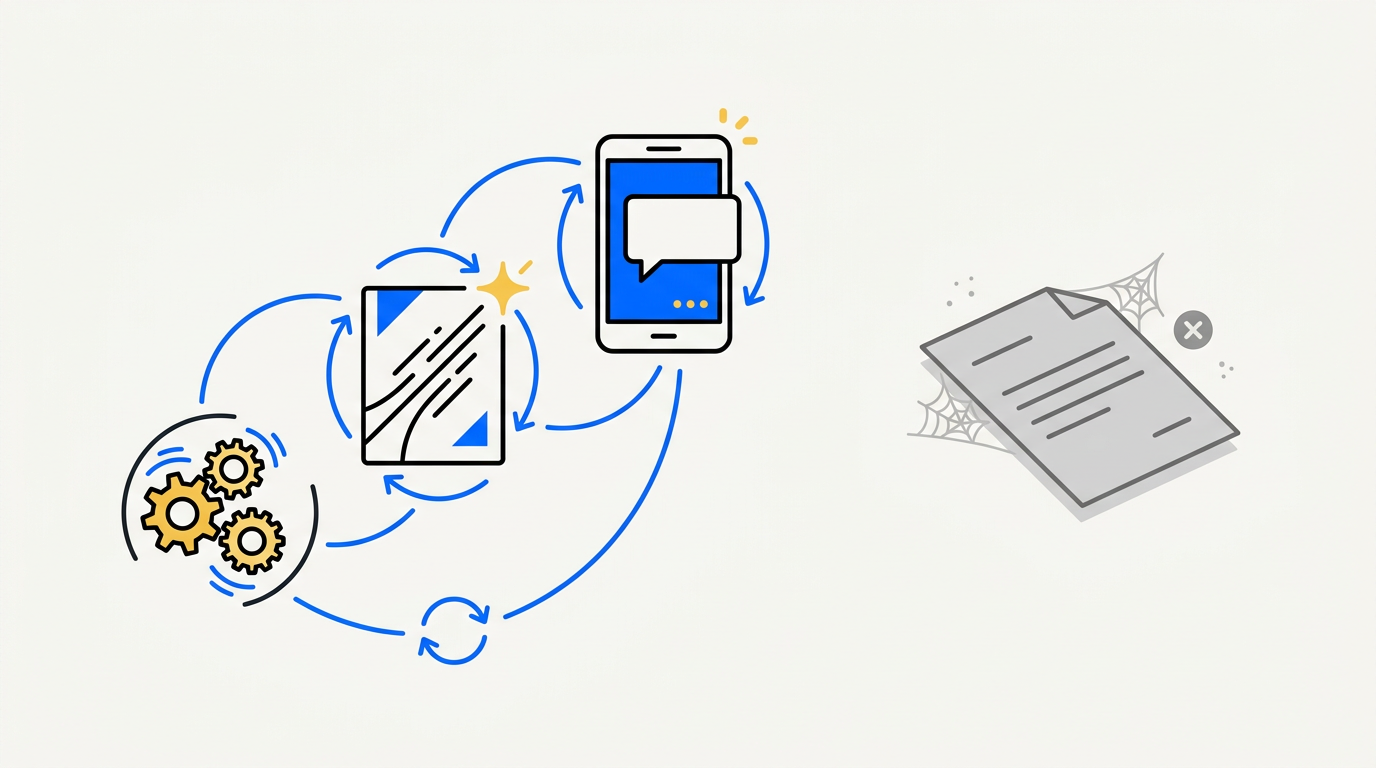
Your SOP library passed the audit. Your floor has never opened it.
That gap — between the document that exists and the instruction that governs — is where most SOP programmes quietly fail. Not at writing. At version 2. The first draft gets done. It is printed, filed, signed off, archived. Then the process changes. A system is updated. A new regulation lands. A senior operator finds a faster path. Nobody updates the PDF. Months later, the floor is running v1 from a laminated sheet while the quality register holds v3. Both exist. Only one is real.
This is not a discipline problem. It is a design flaw.
Why SOPs Rot: A Version-Rotation Failure Taxonomy
Static work instructions decouple from execution the moment they are saved.
The failure modes are predictable and repeating:
- Creation-deployment gap: The instruction is written by someone away from the work, distributed once, and never seen again.
- Version divergence: The document is updated centrally, but the floor still runs the laminated print from two years prior.
- Tribal override: A senior operator's shortcut becomes the real SOP. It is never written down. It leaves when she does.
- Audit theatre: SOPs are current on the register. Workers have never read the current version. The audit passes anyway.
Consider a mid-size regulated firm in Malaysia preparing for an ISO re-audit. Auditors review the SOP register: sixty-three procedures, all stamped current. On the floor, supervisors are running from a laminated print — version 1, dated two years prior. The quality register holds version 3. The audit finds the gap: SOP v3 filed, floor running v1 from a laminated sheet. The finding does not land in the SOP library. It lands in the delta between the library and reality. That delta is the actual compliance risk.
The lesson is not "document better." It is "stop treating documentation as an event."
The Static Document vs. Living Runtime Split
A work instruction is a process's runtime, not its tombstone.
Every process has two versions: the one that is filed, and the one that runs. In organisations that manage work instructions as static documents, these two versions diverge continuously. The faster the organisation moves, the faster the gap grows.
A living SOP closes that gap by design. It lives where the work runs. It updates when the process changes. It is deployed to the people who execute it — not filed where auditors can find it. The version in the register is identical to the version on the floor because they are the same file.
This is not a semantic distinction. It determines whether work instruction software earns its licence fee or becomes another document repository that nobody maintains. Static tools produce artefacts. Living tools produce runtimes.
What Buyers Are Actually Asking For
Search query data reveals what operations managers know but rarely say out loud.
GSC intel from long-form buyer queries shows a sharp pattern. People searching for work instruction software and SOP distribution software are not looking for formatting tools. They are looking for distribution infrastructure. Queries like "how to update sop and notify all staff automatically" and "work instruction automation with version control and approval workflow" describe a system problem, not a writing problem.
One query stands out for its precision: "can sop app send reminders on whatsapp when task pending." That is not a search. That is a system requirement written in plain language by someone who has already lived the failure. The buyer knows a PDF sent by email will not be actioned. They want a channel that people actually use. They want the reminder to fire at the moment the task is due.
This is the real demand signal for work instruction automation in SG and MY: not better documents, but instructions that reach workers, trigger actions, and close the loop.
Document as a Living Moment: The 7-Step AI Lean Cycle
In ESSAM's 7-step AI Lean Cycle, Document is not the end — it is the inflection point.
The cycle runs: Baseline, Map, Analyse waste, Optimise, Document, Deploy, Improve — and then repeats. Document sits at step five deliberately. By that point, waste has been eliminated, the process has been simplified, and what gets documented is the optimised version — not the as-is with its inefficiencies preserved in writing.
ESSAM captures processes conversationally in a single session. No notation software. No workshop prep. No separate documentation sprint after the process design is complete. The conversation produces the SOP, the RACI, the SLA, and the before/after audit view simultaneously. The work instruction is a live artefact of the process model — not a separate deliverable that can drift from it.
When the process changes, the model updates. The work instruction updates with it. Version divergence is structurally prevented, not managed through reminders and goodwill.
By analogy: a Kuwait bank's procurement engagement with ESSAM reduced a 139-day cycle to 57 days — a 59% reduction, 82 days of work retired, 106.9% efficiency improvement, same headcount. That was a procurement engagement, not a documentation project. Most of the gain came from Eliminate and Simplify before anything was automated or documented. Document records what survived the waste analysis. It does not preserve the waste.
WhatsApp Deploy: The Last-Mile Problem, Solved
The distribution failure is not a file-sharing problem. It is a channel problem.
Workers in SG and MY already live in WhatsApp. An instruction deployed via WhatsApp — with task reminders, completion confirmations, and escalation triggers — reaches people where they work, not where the document server lives.
ESSAM deploys work instructions directly to WhatsApp. No new app. No training cycle. The SOP arrives as a task notification. Reminders fire when a step is pending. Completions are logged. The audit trail is automatic.
This is what the buyer who typed "can sop app send reminders on whatsapp when task pending" was asking for. The answer is yes. It is built in. The gap between the filed version and the floor version closes because the deployed version and the filed version are the same object.
The Living-SOP Checklist
A work instruction that does not rot has five properties. Use this checklist when reviewing any SOP in your library:
| Property | What to check | Pass condition |
|---|---|---|
| Owner | Is there a named individual responsible for keeping this current? | Single named owner — not a team or department |
| Trigger | Is there a defined event that initiates a review (system change, audit finding, process update)? | Documented trigger, not calendar-only |
| Version | Is the version in the register identical to what workers execute? | Zero delta between filed and floor |
| Deploy channel | Is the instruction distributed through a channel workers actively use? | Not email or shared drive alone |
| Review cadence | Is there a scheduled next-review date, not just a 'last updated' timestamp? | Next review date is set and owned |
Any SOP that fails two or more of these checks is at rotation risk. The problem is not the content of the instruction. It is the infrastructure around the content. Beautiful writing inside a broken delivery system is still a filing artefact.
The Runtime, Not the Tombstone
"Most organisations treat documentation as the end of a process project," says Abdulla Al-Awadi, ESSAM's founder and former Chief Strategy Officer at a Kuwait bank. "We treat it as the moment the process becomes executable. If the instruction is not deployed, reviewed, and owned — it is not a work instruction. It is a filing artefact."
The audit that finds SOP v3 on the register and v1 on the floor is not finding a documentation failure. It is finding a design failure. The system was not built to keep instructions alive. It was built to produce them once.
Work instruction automation fixes the design. Single-session capture. Living model. WhatsApp deploy. Before/after audit view for every version change. The instruction updates when the process updates. The floor and the register are always the same.
That is not a documentation project. That is a runtime.
Book a demo on your process. Your actual workflow. No hypothetical use case required.
Related reading: WhatsApp SOP deployment guide · What is an AI process engineer? · ESSAM features