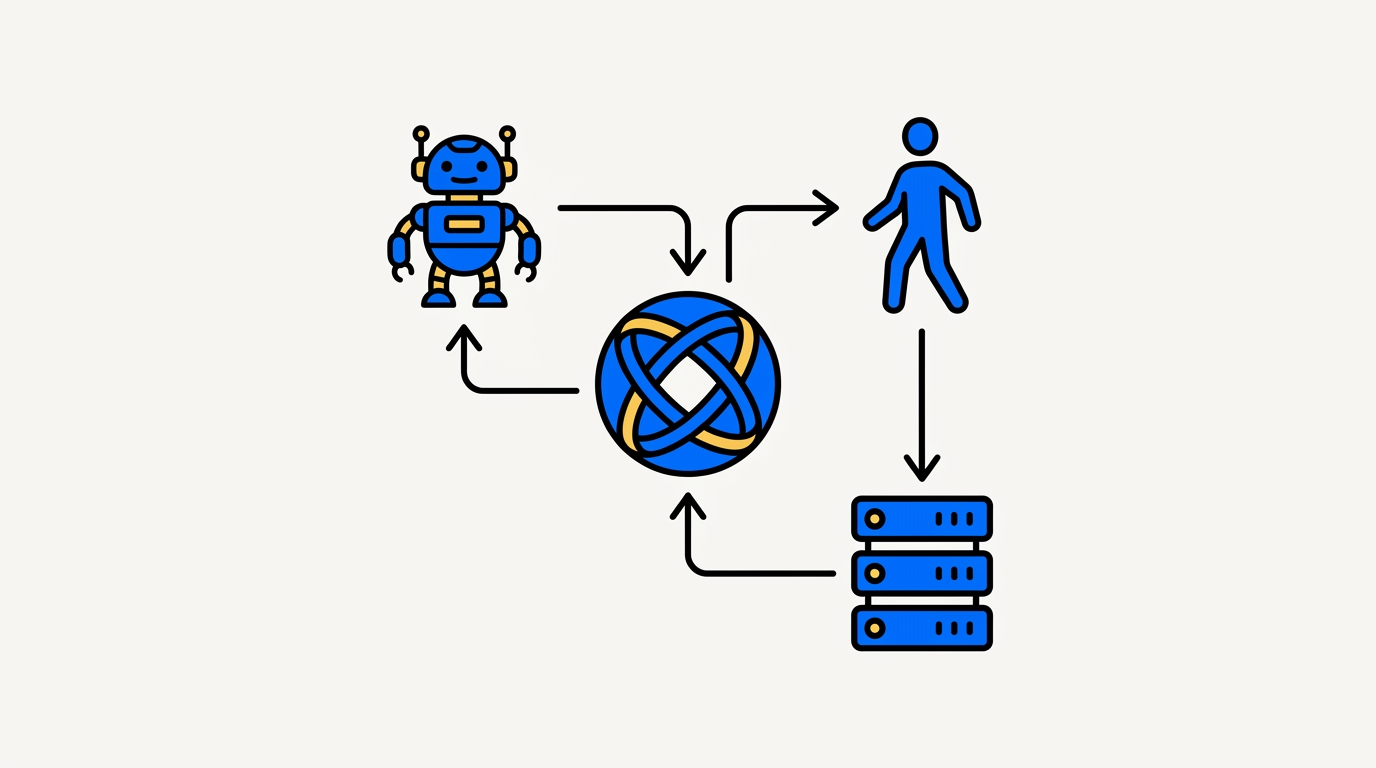
You have 40 bots. You have zero orchestration. That's why every exception ends in an inbox.
The bot completes its task. Then it stops. Something else needs to happen — an approval, a hand-off, a fallback — and no rule governs what that something is. So it lands in someone's inbox, and they decide. They decide every time, differently, depending on who is on shift and how busy they are. That is not automation with gaps. That is an undesigned process that automation has made faster to fail.
Automation Does the Step. Orchestration Decides the Sequence.
The defining difference is not sophistication — it is scope. Automation is task-level: a bot extracts data, a script writes a record, a form routes a submission. Orchestration is flow-level: something decides what happens next, who handles the exception, which system receives the output, and in what order. Automation does the step. Orchestration decides the sequence.
Most banks in Singapore and Malaysia have invested heavily in task-level automation over the last decade. They have bots, scripts, rules engines, and workflow forms. What they frequently lack is the coordination layer that ties those parts into a governed, visible, recoverable sequence. When that layer is missing, the process still runs — it just runs inside human heads, on instant messages, and in undocumented escalation chains.
The 2am Failure: A Test of Whether Orchestration Exists
Consider an illustrative scenario that is familiar to most automation programme leads. A bot fails at 2am during a batch reconciliation. The failure is logged. Nothing else happens automatically. By 7am, a downstream team notices the data is incomplete. They contact the bot owner. The bot owner escalates to IT. IT fixes the bot and reruns. The reconciliation is eight hours late, and three people spent part of their morning diagnosing something that a designed exception route would have handled in minutes.
This is not a bot problem. The bot failed — bots do. The problem is that no rule existed for what should happen when it did. Orchestration is the layer that defines: on failure, re-queue; on timeout, alert; on human input required, route to approver. Without that layer, exception handling is improvised. And improvised exception handling does not scale.
Why the Terminology Confuses Buyers
Browse any open-source project directory and search for "workflow-automation" — you will find hundreds of tools tagged identically, regardless of whether they handle tasks or sequences. This is a signal worth taking seriously, not because developers are confused, but because the tagging reflects genuine category ambiguity at the buyer level. Ops leads evaluating tooling cannot easily distinguish between "this tool runs a step" and "this tool coordinates a sequence." The tools rarely make the distinction clear.
The result: teams buy orchestration tools and use them as automation tools. Or they extend automation tools into orchestration roles they were not designed for. Either way, the coordination layer remains implicit. It lives in documentation nobody updates, in the institutional knowledge of the person who built the bot, and in the inbox of whoever is on call.
The Three-Layer Test for Your Automation Estate
The clearest way to diagnose an automation programme is to separate three questions that most teams conflate.
| Layer | Question | Who or What Answers It |
|---|---|---|
| Step — Automation | Can a bot or script execute this task reliably? | Technology |
| Sequence — Orchestration | What happens next, and who decides? | Rules — not people |
| Should it exist? — Process Design | Does this step and this sequence belong in the process at all? | Process engineering |
Most programmes have answers for the first row. Many lack answers for the second. Almost none ask the third question before building. That order matters enormously. When process design runs after automation, teams spend engineering time orchestrating steps that should have been eliminated. When it runs before, the orchestration layer is simpler — because fewer steps need coordinating.
"Orchestration is the layer buyers skip, then pay for twice," says Abdulla Al-Awadi, ESSAM's founder and former Chief Strategy Officer at a Kuwait bank. "They skip it because they think the bots are the product. Then they pay for it when every exception becomes a manual task and every scaling decision requires rewriting the logic."
Where the E-S-S-A-M Framework Positions Orchestration
ESSAM is explicit about sequence: Automate is the fourth action, not the first. The framework runs Eliminate, then Simplify and Standardise, then Automate. Orchestration belongs in the Migrate phase — the fifth action — where bot workloads are migrated into designed sequences with defined hand-off rules, fallback paths, and human touchpoints.
This matters for banks with an existing automation estate. If bots were deployed before the process was designed, the Migrate phase is where the coordination layer is rebuilt properly. Not by replacing the bots, but by wrapping them in a governed sequence. The sequence becomes an explicit artefact of the programme, not an assumption held in someone's head.
ESSAM captures that sequence conversationally, in a single session. No notation software, no workshop preparation. The output includes the process model, SOPs, SLAs, RACI assignments, and policies — produced from the live model. Failure-mode analysis can run before go-live, so the 2am exception route exists on day one.
WhatsApp as the Human-Side Orchestration Endpoint
The human layer of orchestration — approvals, escalations, confirmations — needs an interface people will actually use. In Singapore and Malaysia, WhatsApp carries near-universal adoption. No new application, no training cycle, no change-management overhead. When ESSAM deploys a process to WhatsApp, it is not adding a messaging channel. It is closing the orchestration loop: the bot hands off to a human via the channel the human already uses, with the context and the required action included.
A rule governs the hand-off. The human acts. The sequence continues. That is orchestration made usable.
The Design Principle That Changes the Calculation
In the ESSAM 7-step AI Lean Cycle — Baseline, Map, Analyse waste, Optimise, Document, Deploy, Improve — orchestration becomes designable at the Optimise and Document steps, before anything is deployed. The sequence is agreed, documented, and validated before bots run. The coordination layer is a designed output, not an emergent property of whatever the bots happen to produce.
By analogy: a Kuwait bank running a procurement engagement reduced cycle time from 139 days to 57 days. That is a 59% reduction, with 82 days of work retired and no additional headcount. The gain came primarily from Eliminate and Simplify, before a single automation was added. The orchestration of the remaining steps was straightforward because the unnecessary steps had already been removed. The same principle applies to any bot estate: orchestration is easiest to design when you start with fewer things to coordinate.
Frequently Asked Questions
What is workflow orchestration?
Workflow orchestration is the coordination layer that determines what happens next in a process — which system, bot, or person acts, in what order, and under what conditions. It is distinct from automation, which executes individual tasks. Orchestration governs the sequence; automation executes the steps within it. A process can have both, either, or neither — but a governed, recoverable process requires both.
What is the difference between orchestration and automation?
Automation is task-scoped: a bot extracts data, a script updates a record, a rules engine fires a condition. Orchestration is flow-scoped: a rule decides what follows — which system receives the output, who approves the exception, what triggers the next step. You can operate automation without orchestration. When you do, exception handling becomes human and informal. Orchestration replaces that with rules.
Where does AI process engineering fit in workflow orchestration?
AI process engineering — as practised in the ESSAM framework — designs the orchestration layer before bots are deployed. It captures cross-system sequences in a single session, identifies which steps should be eliminated before automation, and produces the SOPs and RACI assignments that make the coordination layer governable. Process engineering is what makes orchestration designable rather than hardcoded. Without it, orchestration accumulates as an undocumented residue of decisions made during deployment.
Book a demo on your process. Your actual workflow. No hypothetical use case required.
Related reading: What is an AI Process Engineer? · AI Process Automation vs RPA in Banking · Features