The question most practitioners are asking about agentic AI is the wrong one.
The Question That Is Setting You Back
Can agentic AI replace a Lean Six Sigma Black Belt?
That is what operations directors are debating. It is also completely beside the point.
Your Black Belt spent six months getting certified. Your last process improvement report took three weeks and is already outdated. Agentic AI does not replace the certification. It replaces the three weeks.
The bottleneck in most process improvement programs is not capability. Black Belts know exactly what is wrong. Green Belts can identify the waste. The bottleneck is time — specifically, the 80% of practitioner time consumed by documentation, reporting, SOP writing, and chasing approval signatures (industry research, 2025). That is the 80% that agentic AI was built for.
What Is Agentic AI? (Plain Language)
Agentic AI is not a chatbot. It is not a copilot that waits for your prompts. It is not a dashboard that surfaces insights and leaves the work to you.
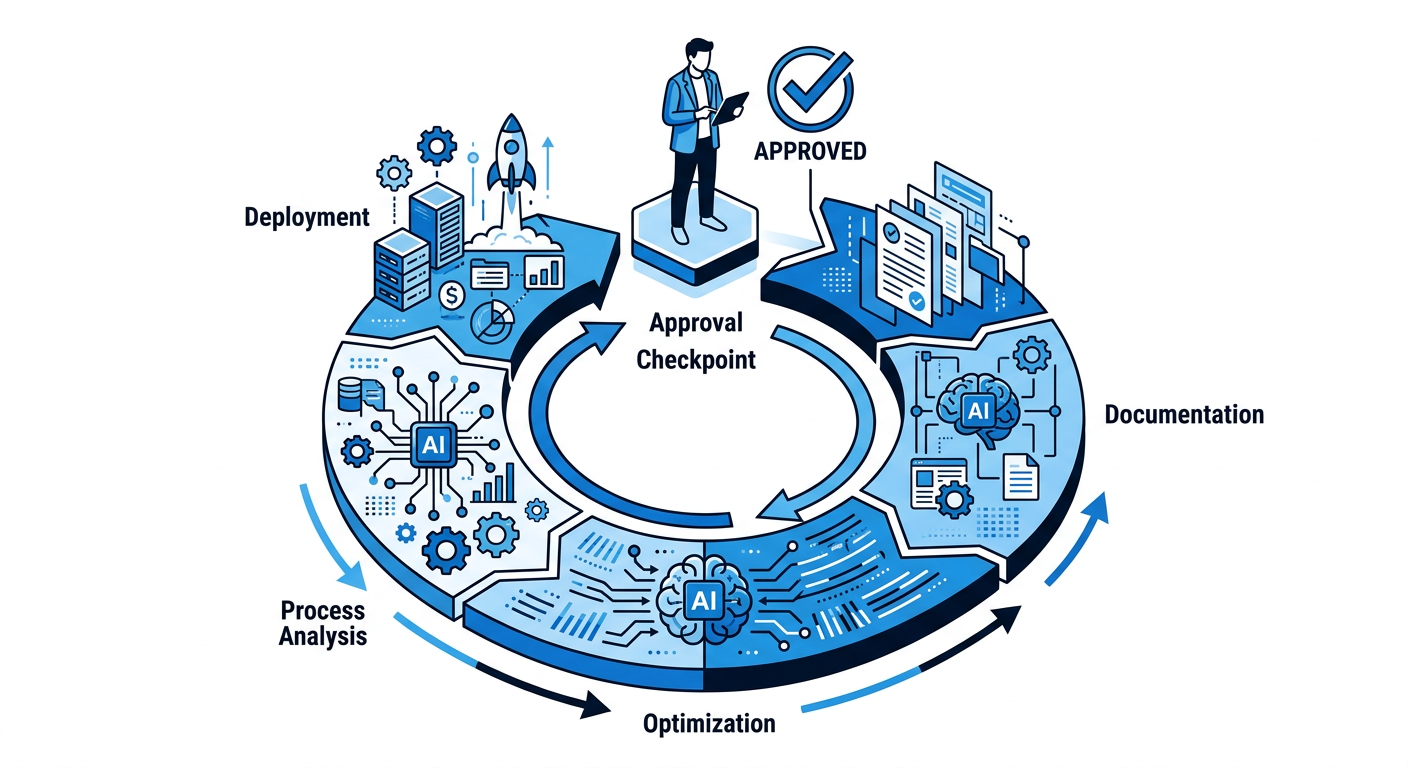
An agent operates in cycles. It analyses a situation, forms a recommendation, executes within approved parameters, and improves its approach based on feedback. Then it repeats. Without being asked.
This is the defining characteristic: autonomous cycles with human checkpoints, not passive assistance on demand.
For process improvement, an agentic AI system does the following:
- Monitors process data continuously — cycle time, defect rates, throughput, rework
- Identifies deviation patterns and ranks them by impact
- Proposes improvement actions aligned with your methodology (DMAIC, Lean, Kaizen)
- Drafts the documentation — current-state maps, future-state maps, FMEA entries, SOPs
- Submits recommendations for practitioner review and approval
- Executes approved changes within its defined scope
- Tracks outcomes and feeds results back into the next improvement cycle
Every substantive change requires human approval. The agent does not act unilaterally on process changes. It acts unilaterally on the work that surrounds process changes — the analysis, the documentation, the reporting.
That distinction matters for compliance.
How Is Agentic AI Different From What You Already Have?
vs. BPM Platforms
Business process management platforms are static workflow engines. They enforce a defined process. They do not redesign it. There is no mechanism for identifying that the process should change or proposing what change would reduce cycle time.
Agentic AI operates on improvement cycles, not execution cycles. It is not monitoring whether your current process runs correctly. It is analysing whether your current process should continue running at all.
vs. Traditional Consulting
A consulting engagement produces a report. That report reflects conditions at the time of the engagement. Six months later, your process has drifted, your volume has changed, and the recommendation is stale.
Agentic AI runs continuously. There is no engagement window. The improvement cycle does not end when the project closes.
vs. Manual DMAIC
Manual DMAIC is practitioner-driven. The Black Belt plans every phase, executes every analysis, writes every deliverable, and presents every recommendation. This works. It also means one practitioner can run two to three improvement cycles per quarter, at best.
AI-augmented DMAIC shifts the ratio. The practitioner owns Define, approves Analyse findings, validates the Improve recommendation, and signs off on Control documentation. The agent handles the analytical and documentation workload within each phase.
What This Looks Like in Practice
In February 2026, a team documented what happened when they deployed an agentic operations system across their workflows. The team handled 2,400 tasks per month. Before the deployment, they spent most of their time on reactive firefighting — responding to problems as they escalated.
After deployment, the team moved from reactive firefighting to exception review and process improvement. That is a meaningful reallocation of how practitioners spend their time.
The same team flagged what operations leaders should prepare for: change management proved more challenging than the technical build. Trust-building is a deliberate phase, not a soft concern.
This is consistent with what operations teams encounter at scale. The AI readiness question is not technical. It is organisational.
The Backlog Problem That Agentic AI Solves
Consider a process improvement team lead with 12 processes on her backlog. In a good quarter, her team completes two. The other ten wait. Two have been backlogged for over a year.
This is not unusual. According to ESSAM research, 70% of process improvement initiatives fail past year one. The leading cause is not bad analysis. It is implementation failure — the gap between a completed DMAIC report and an executed SOP.
That gap is almost entirely administrative. Documenting the improvement. Writing the SOP. Building the presentation deck. Updating the FMEA. Preparing the audit trail.
When agentic AI handles that gap, the math changes.
In week one of using ESSAM, that team lead completes three backlogs — not because the improvement work became easier, but because the documentation, presentation, and SOP phases are handled by the platform. In week four, her backlog is cleared. Her team is working on new improvements, not old paperwork.
ESSAM's 7-Step AI Lean Transformation Cycle
ESSAM structures agentic AI for process improvement across seven steps. Here is what the AI handles and what the practitioner handles at each stage.
| Step | What AI Handles | What Practitioner Handles |
|---|---|---|
| 1. Baseline | Pulls process data, builds current-state map, calculates baseline metrics | Validates scope and confirms data sources |
| 2. Gap Analysis | Identifies deviation patterns, ranks by impact and frequency | Reviews and prioritises findings |
| 3. Root Cause | Runs fishbone and FMEA analysis against process data | Approves root cause selection |
| 4. Improvement Design | Drafts future-state options with projected cycle time and yield impact | Selects improvement path |
| 5. Documentation | Writes SOPs, control plans, updated FMEA entries, and audit trail entries | Reviews and signs off |
| 6. Execution Tracking | Monitors post-implementation metrics against targets | Reviews exception flags |
| 7. Control Handoff | Generates control documentation, variance thresholds, escalation rules | Approves control plan and closes cycle |
The practitioner's role is decision-making and judgment. The agent's role is analysis, documentation, and monitoring. Neither replaces the other. They are not competing for the same tasks.
The Two Objections Practitioners Raise (And the Honest Answers)
"AI cannot be trusted for compliance in regulated industries."
The concern is legitimate. In regulated environments — medical devices, financial services, food manufacturing — every process change carries audit and liability implications.
In ESSAM's model, the agent does not approve changes. The practitioner does. The agent generates the documentation, the analysis, and the recommendation. A named human reviews and approves each step before it is executed. That approval is logged, timestamped, and auditable.
The agent accelerates the compliance documentation process. It does not bypass the compliance review.
"Change management is harder with AI involved."
This is accurate, and real-world deployments confirm it. Trust-building is not a soft concern. It is an implementation phase.
ESSAM addresses this through WhatsApp-based deployment, which meets practitioners and frontline teams where they already work. No new interface to learn. No portal to log into. No system adoption campaign to run. The agent surfaces inside existing communication patterns, which reduces the organisational friction that kills most change management programs.
What Changes When the 80% Is Handled
When 80% of practitioner time is no longer consumed by documentation and reporting, three things happen.
Practitioners work on more improvements. The constraint was never knowledge or methodology. It was time. Remove the time constraint and throughput increases.
Improvements reach implementation. The 70% failure rate (ESSAM research) is an implementation failure, not an analysis failure. Practitioners know what to do. They run out of bandwidth before they can do it. Agentic AI closes that implementation gap by handling the work between analysis and execution.
Practitioner expertise compounds. A Black Belt working on two improvements per quarter accumulates limited experience. A Black Belt working on eight improvements per quarter builds expertise faster, encounters more edge cases, and develops sharper judgment. The agent does not dilute that expertise. It creates the conditions for it to grow.
FAQ
What is agentic AI for process improvement?
Agentic AI for process improvement is a system that operates in autonomous cycles — analysing process data, identifying gaps, proposing improvements, generating documentation, and tracking outcomes — with human approval at each substantive decision point. It is distinct from chatbots, copilots, and BPM platforms in that it initiates action rather than waiting to respond to prompts.
Can agentic AI replace a Lean Six Sigma Black Belt?
No. Agentic AI handles the analytical and documentation work that consumes 80% of practitioner time (industry research, 2025). It does not replace the judgment, stakeholder management, or methodological expertise that a Black Belt provides. It reallocates practitioner time from administrative work to improvement work.
How does agentic AI handle compliance in regulated industries?
In ESSAM's model, all process changes require practitioner approval before execution. The agent generates documentation, analysis, and recommendations. A named human reviews and approves each step. Every approval is logged, timestamped, and auditable. The agent accelerates compliance documentation — it does not bypass compliance review.
What is the difference between agentic AI and traditional BPM tools?
BPM platforms enforce defined processes. They do not redesign them. Agentic AI operates on improvement cycles — it identifies whether a process should change, proposes what change would reduce waste or cycle time, and tracks whether the change achieved its target. BPM is execution. Agentic AI is continuous improvement.
The Last Word
Agentic AI for process improvement does not replace the Black Belt. It gives the Black Belt back to the process.
Your practitioners know exactly what is wrong. Agentic AI gives them the time to fix it.
See ESSAM in Action
Ready to clear your improvement backlog?
Most process improvement teams finish fewer than three initiatives per quarter — not because the work is too hard, but because the documentation never ends. ESSAM's AI Lean Transformation Cycle handles the 80% so your practitioners can work on the 20% they were hired for. Book a 30-minute session to see how it maps to your current DMAIC workflow.
Book a session → apac.essam.ai/contact
Related reading: What is ESSAM? · Is DMAIC Dead? · ESSAM Features