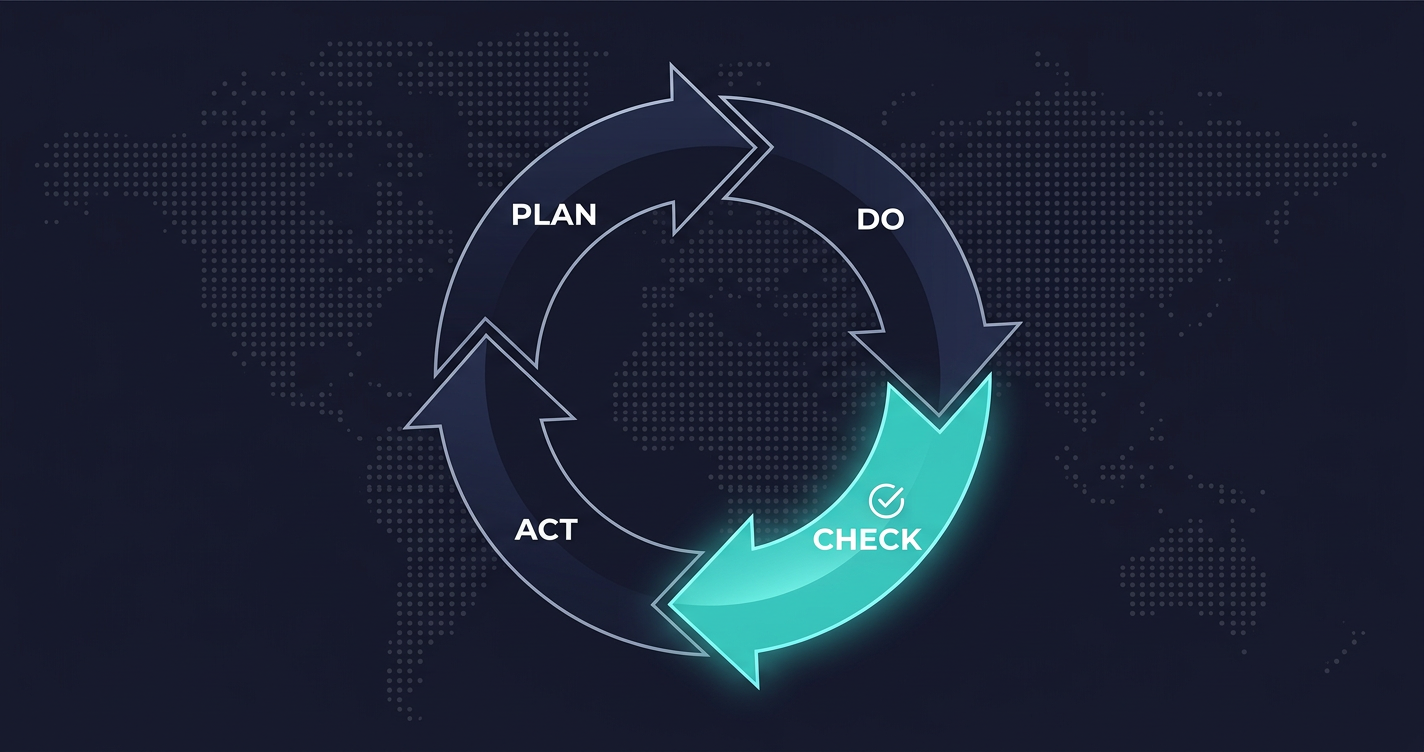
Sixty-three percent of process improvement initiatives in financial services stall before reaching the Act step. Not because the method is broken. Because teams skip a single specification in Plan that makes Check impossible to execute with confidence.
PDCA—Plan, Do, Check, Act—is the most-repeated framework in Lean. It is also the most reliably frustrating when teams run it without understanding why Check keeps delivering inconclusive results. The fix is almost never in Check. It is in Plan, written three weeks earlier, before anyone touched a process.
Why banking operations teams are particularly vulnerable to getting it wrong, and how to run a PDCA cycle that actually closes.
The real reason PDCA feels annoying
There is a complaint that surfaces in operations forums and Lean retrospectives with uncomfortable regularity: PDCA "can be very annoying, but it's the fastest way to improve." Both halves of that are true.
The frustration comes from a specific failure mode. Teams reach Check, look at their data, and find themselves saying some version of: "Seems like it improved a bit." That ambiguity is not a data problem. It is a planning problem.
When Plan does not specify what "enough" looks like—a numeric target, a baseline, a timeframe—Check has nothing to compare against. The team is not evaluating a hypothesis. They are staring at a number with no reference point. The cycle either restarts with no conclusion or gets abandoned as inconclusive.
The fix is four words written into Plan before Do begins: metric, baseline, target, timeframe.
PDCA step by step: what each phase actually requires
Plan
Most teams treat Plan as problem identification. It is not. Plan is hypothesis construction.
A properly written Plan contains four things:
Problem definition. What is going wrong, for whom, at what frequency? "Loan applications are being rejected at the operations stage" is not a problem definition. "Incomplete loan applications submitted by branch staff are running at 12% of all submissions, causing an average 4.7-day rework cycle per case" is.
Baseline metric. The number as it stands today, measured with the same method you will use to measure the outcome. If you measure pre-intervention with manual sampling and post-intervention with system data, you are not comparing the same thing.
Target. The specific number that would constitute success. Not "lower than today." A number. "Incomplete submission rate below 5% within six weeks of pilot launch."
Hypothesis. Your causal claim about why the change will produce the target. "If branch staff receive a real-time progress indicator during application entry, incomplete submissions will fall because the primary cause is staff not knowing which fields are mandatory before submitting."
Without the hypothesis, you are not running an experiment. You are making a change and hoping.
Do
Do is the pilot, not the rollout. This is where teams go wrong a second time: scaling before checking.
Scope the Do step aggressively small. One branch. One team. Twenty percent of traffic. The goal is not to prove the change works at scale. The goal is to generate enough signal to evaluate the hypothesis without committing to full implementation.
Define the pilot parameters in Plan before Do begins: which subset of operations, how long the pilot runs, who captures data, and what data gets captured.
Check
Check requires almost no original thinking if Plan was done correctly.
One question: did actual results match the prediction?
Not "did things improve?" but "did things improve to the level, in the timeframe, and through the mechanism we specified?"
If Plan said incomplete submissions should fall below 5% in six weeks and Check shows 6.3% at week six, the answer is not "it worked." The answer is "partially—the hypothesis was directionally correct, the target was not met, and something in the mechanism did not fully resolve." That is useful. That is the input to Act.
If Check shows 6.3% and Plan said only "we expect improvement," you have nothing. The 6.3% could be spectacular progress or a failure. Without a baseline target, you cannot tell which.
Act
Act has two valid outcomes.
Standardize. If Check confirmed the hypothesis and met the target, embed the change into standard operating procedure. Update training materials, process documentation, and system configurations. Begin the next PDCA cycle on the next problem.
Return to Plan. If Check did not meet the target, you now have new information. Act is not "keep trying the same thing." Act is distilling what Check revealed—which part of the hypothesis held, which part did not—and writing a tighter Plan for the next cycle.
Act is not "scale it up and see what happens." That is how organizations end up with half-validated changes baked into core operations.
The Check step fix: specify success in Plan
The single most actionable change any team can make to their PDCA practice: before leaving Plan, write down the sentence that will close the loop in Check.
The sentence structure is: "We will consider this cycle successful if [metric] reaches [target] within [timeframe], as measured by [measurement method]."
If you cannot write that sentence, you are not ready to begin Do.
This sounds like overhead. It is not. Writing that sentence takes four minutes. The alternative—running a six-week pilot, reaching Check, and having no conclusion—costs four to eight weeks of rework, team frustration, and lost confidence in the method.
Banking operations teams are particularly vulnerable to skipping this step because measurement infrastructure is often inconsistent. Data lives in multiple systems. Baseline numbers require manual extraction. It is easier to skip the specification and tell yourself you will figure out measurement when you get to Check.
You will not. You will arrive at Check, discover the data you needed was not captured, and call the cycle inconclusive.
A banking example: loan incomplete submission rate
Here is a complete PDCA cycle from a loan origination operations context.
Plan
- Problem: Incomplete loan applications submitted by branch staff are running at 12% of all applications, generating manual rework and extending time-to-decision.
- Baseline: 12% incomplete submission rate, measured over 90 days via system log data.
- Target: Incomplete submission rate below 5% within six weeks of pilot launch.
- Hypothesis: Branch staff are submitting incomplete applications because the entry interface does not surface missing mandatory fields until final submission. Adding a real-time completion progress indicator during entry will reduce incomplete submissions by surfacing gaps before submission.
Do
- Pilot: 20% of branch application traffic, routed to the modified interface.
- Duration: Six weeks.
- Data capture: System log, automated, same methodology as baseline.
Check
- Result at week six: Incomplete submission rate in pilot group: 6.3%.
- Target was: below 5%.
- Assessment: Hypothesis was directionally correct—rate dropped from 12% to 6.3%, a 47.5% reduction. Target not met. Remaining gap suggests a secondary cause not addressed by the progress indicator alone.
Act
- Return to Plan. Write second PDCA cycle. New hypothesis: remaining 6.3% incomplete submissions are concentrated in applications involving non-standard collateral types, where mandatory fields are context-dependent and not surfaced by the static progress indicator.
- Second cycle Plan: Add dynamic field logic for collateral-type-specific requirements.
This is how PDCA is supposed to close. Check did not confirm full success, but it confirmed the hypothesis direction and isolated the remaining cause with precision. That is what a properly specified Plan produces.
PDCA vs. DMAIC: choosing the right framework
PDCA and DMAIC are not interchangeable, and using the wrong one at the wrong time is a real source of process improvement fatigue. For a deeper comparison, see DMAIC vs PDCA: Which to Use.
The practical distinction is root cause certainty.
PDCA is the right choice when you already know, or have a strong hypothesis about, the root cause. The loan example above works with PDCA because the team had a specific, testable hypothesis: the interface does not surface missing fields during entry. PDCA lets you test that hypothesis quickly and iterate.
DMAIC is the right choice when you do not know the root cause, or when the problem has multiple interacting causes that require structured statistical analysis to isolate. DMAIC's Measure and Analyze phases are built to identify root causes from data. PDCA skips that work—efficient when you have the answer, dangerous when you do not.
Using PDCA on an unknown root cause produces a cycle that either confirms a wrong hypothesis (and embeds an ineffective change) or cycles endlessly without convergence.
Using DMAIC on a known root cause adds eight to twelve weeks of structured analysis to a problem that could be solved in six.
Lean operations teams in banking tend to overuse DMAIC for its rigor and underuse PDCA for its speed. The routing question before every improvement initiative: do we know the cause?
What PDCA looks like at scale: the Kuwait example
A regional bank in Kuwait reduced average loan processing time from 139 days to 57 days—a 59% reduction—through structured PDCA cycles applied to its loan origination and credit review workflow. That result did not come from a single cycle. It came from sequential PDCA cycles, each one isolating a specific bottleneck, specifying a numeric target, piloting a change, and either standardizing or iterating.
The 59% reduction is the compounded output of cycles that each closed cleanly. Clean closure required Plan to specify success before Do began.
This is the operating model that E-S-S-A-M is built to support: iterative, evidence-based improvement cycles embedded into banking workflows, with measurement infrastructure that makes the Check step executable rather than aspirational.
Why your Check step keeps coming back inconclusive
Operations leaders who have run frustrated PDCA cycles often attribute the problem to their teams, their data quality, or the framework itself. The diagnosis is almost always upstream.
Inconclusive Check steps are a Plan specification failure. The cycle did not fail at Check. It failed three weeks earlier when no one wrote the sentence: "We will consider this cycle successful if [metric] reaches [target] within [timeframe]."
This is also why PDCA gets a reputation for being slow. When Check is inconclusive, teams restart from Plan—but without the diagnostic information that a properly closed Check would have generated. They are not iterating. They are repeating.
The speed of PDCA comes from tight cycles with clear closure criteria. Each closed cycle generates a specific finding. The process improvement KPIs that matter—cycle time, defect rate, rework rate—move in measurable steps.
For teams building a broader continuous improvement culture, the Kaizen methodology provides complementary principles: small, frequent improvements owned by the people closest to the process, measured against a baseline. PDCA is the execution engine for Kaizen thinking.
The ESSAM approach
ESSAM is an AI-native Lean process transformation platform built for banking operations. The platform embeds PDCA cycle management into core banking workflows—not as a documentation layer, but as the operational infrastructure for running, measuring, and closing improvement cycles.
Where most teams struggle with the Plan specification step because measurement infrastructure is fragmented across systems, ESSAM provides baseline capture, target-setting templates, and Check-step data aggregation from existing banking systems. The cycle closes because the data is there when you need it.
Teams using ESSAM report not that PDCA became less annoying, but that it became less ambiguous. Check stopped being a conversation about whether things seemed better. It became a comparison of a number to a target.
Frequently Asked Questions
What is the PDCA cycle in banking operations?
The PDCA cycle—Plan, Do, Check, Act—is a four-step iterative improvement method used to solve operational problems in banking workflows. In banking, it applies to processes like loan origination, compliance review, onboarding, and transaction reconciliation. Each cycle tests a specific hypothesis about a process change, measures the result against a defined target, and either standardizes the change or iterates.
Why does the Check step so often feel inconclusive?
Because Plan did not specify what success looks like before Do began. Check can only compare actual results to a prediction. If Plan contained no numeric target, no baseline, and no timeframe, there is nothing to compare against. The fix is in Plan: write a success criterion before the pilot starts.
How is PDCA different from DMAIC?
PDCA assumes you already know, or have a strong hypothesis about, the root cause. It is faster and built for rapid iteration when the problem is well-understood. DMAIC includes structured root cause analysis phases (Measure, Analyze) and is appropriate when the cause is unknown or when multiple interacting causes need to be isolated statistically. Use PDCA for known causes, DMAIC for unknown ones.
How many PDCA cycles does it take to solve a banking process problem?
It depends on the complexity of the root cause. Simple problems with a single cause may close in one or two cycles. Multi-cause problems—like loan processing delays driven by both interface gaps and collateral-type logic—typically require sequential cycles, each isolating a component of the problem. The Kuwait loan processing example involved multiple cycles before reaching the 59% reduction in processing time.
What role does ESSAM play in running PDCA cycles?
ESSAM provides the measurement infrastructure and workflow integration that makes PDCA executable in banking environments. The platform captures baseline metrics from existing systems, structures Plan specifications, tracks pilot results for Check, and logs standardized changes into operational documentation. Teams spend their time on analysis and decision-making rather than data extraction and manual tracking.
If your last PDCA cycle ended with "seems like it improved a bit," the issue is in your Plan specification—not your Check step. Talk to the ESSAM team about how the platform structures success criteria before pilots begin.