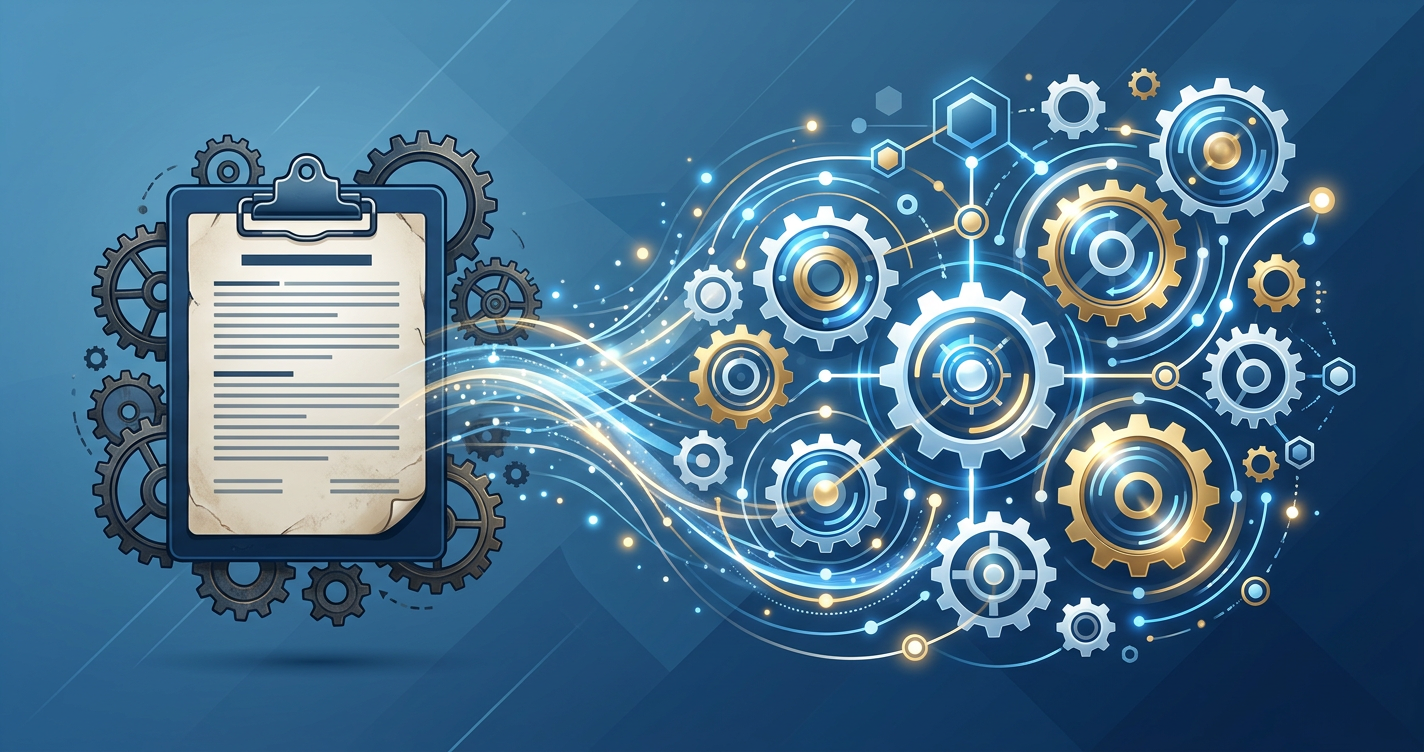
70% of process improvement projects fail to sustain results past year one. Not because the consultants were bad. Because the model they delivered in was built for completion, not continuity.
That distinction matters more than the invoice.
What a Process Improvement Consultant Actually Delivers
A process improvement consultant delivers three things: diagnosis, documentation, and a final report. Then they leave.
That's not a criticism. That's the model.
Traditional consulting engagements are scoped around a deliverable: a process map, a gap analysis, a set of SOPs, a transformation roadmap. The consultant arrives, observes, interviews, documents, presents, and exits. The work is finished when the document is signed off.
The question nobody asks before signing the contract: who maintains this after they're gone?
Consultants are excellent at the front end of the improvement cycle. In DMAIC terms (the Six Sigma framework for process improvement), they excel at:
- Define: scoping the problem, setting objectives, aligning stakeholders
- Measure: baselining performance, identifying variation, mapping current state
- Analyze: root cause analysis, gap identification, prioritization
These are high-skill, high-judgment phases. A seasoned consultant adds real value here. You are paying for pattern recognition built across hundreds of engagements.
But DMAIC has two more phases: Control and ongoing Improve. These are not one-time activities. They require systems, ownership, and iteration. They require someone to be there next quarter when the process drifts, when a new hire joins, when the regulation changes.
A consulting engagement does not budget for that. The model does not allow for it.
The Structural Gap: Point-in-Time vs. Continuous
A consulting engagement produces a finished product: a set of SOPs, a process map, a recommendations deck. These are artifacts — static documents that represent how the process looked at the moment of engagement.
Processes are not static. They drift. People leave. Systems change. Workarounds get introduced. The SOP that was accurate on the day the consultant presented it is already partially obsolete six months later.
This is not a failure of the consultant's work. It is a structural property of the delivery model. A finished document cannot update itself. It cannot flag when a step is no longer being followed. It cannot surface the new bottleneck that emerged after the ERP migration.
Traditional consulting engagements are optimized for diagnosis and recommendation. They are not designed for ongoing control.
The model gap, in plain terms:
| Dimension | Consulting Engagement | Process Platform |
|---|---|---|
| Delivery format | Document / report | Live system |
| Duration | 3–6 months | Continuous |
| Ownership post-engagement | Client (alone) | Shared / embedded |
| SOP maintenance | Manual, ad hoc | Built-in, versioned |
| Cost structure | $50,000–$200,000 one-time | ~$200/month ongoing |
| Time to deploy | Weeks of onboarding | 2–3 days |
| Team size fit | Enterprise transformation | Small Six Sigma team (2–5 people) |
| DMAIC coverage | Define, Measure, Analyze | Control, Improve |
Neither column is wrong. They are solving different problems across different timeframes.
When a Consultant Is the Right Call
There are situations where a process improvement consultant is exactly what you need:
- Regulatory investigation or compliance audit: You need external credibility and documented methodology. An independent consultant carries weight that an internal platform report does not.
- Board-level transformation initiative: Change at that scale requires human facilitation, political navigation, and stakeholder management that no platform provides.
- One-time structural redesign: If you are re-engineering a core process from scratch and need deep expertise to challenge assumptions, a consultant's outside perspective is genuinely valuable.
- Capability building: If your team has never run a structured improvement cycle, a consultant can train and model the methodology in ways that accelerate internal capability.
These are legitimate use cases. If you are in one of them, hire a consultant. The investment is justified.
The problem is not the consulting model. The problem is using it as the default answer for a problem that requires continuous operating infrastructure.
When a Platform Is the Right Call
You are not in a regulatory investigation. You are running operations. Processes change week to week. Your team is small: two to five people responsible for improvement across multiple functions. You do not have $100,000 to spend on an engagement every time a workflow needs updating.
You need:
- SOPs that are live and editable, not PDFs sitting in a shared drive
- A way to track whether processes are actually being followed
- A system that flags drift before it becomes a failure
- Onboarding that takes days, not months
- A cost structure that fits an ongoing function, not a one-time project
This is not consulting-lite. It is a different operating model.
A consulting firm produces a finished product and hands it to you. A process platform is infrastructure — something your team operates in, not something delivered to you.
The Maintenance Gap Nobody Budgets For
One operations manager, writing about a $200k process mapping engagement, put it plainly:
"The consultant was great. The handoff was terrible. Nothing was in a format our team could actually use or update."
This is not a story about a bad consultant. The work was thorough. The final presentation was credible. The failure was structural.
The engagement ended. The documents were handed over. The team, with no system for maintaining or operationalizing what had been delivered, defaulted back to what they knew.
When you scope a consulting engagement, the budget covers the work the consultant does. It does not cover the tooling, training, and ongoing effort your team will need to keep that work alive. That cost is invisible in the proposal and real in the aftermath.
One manufacturer tracked their cycle time before and after a process engagement: 139 days down to 33.5 days. Eighteen months later, without a system to sustain the changes, they had drifted back to 98 days. The 30% of revenue that operations literature consistently attributes to process failure is not lost in the moment of the breakdown. It is lost in the slow accumulation of drift, workaround, and undocumented exception that builds up after the consultant leaves.
The Category Error
When someone searches for a "process improvement consultant alternative," they are usually asking the wrong question.
The question implies: I need the same outcome a consultant delivers, but cheaper or faster.
The better question: what outcome do I actually need?
If the answer is a one-time diagnosis — a clear, external, credible assessment of what is broken and why — then the consultant is not something to replace. It is the right tool.
If the answer is operational infrastructure, a system that keeps processes documented, maintained, and improving over time, then the consulting model is structurally mismatched with the need. Not because of cost. Because of design.
A consultant gives you the map. A platform gives you the navigation system. You do not re-buy a navigation system every time the roads change.
FAQ
Can I use both a consultant and a platform?
Yes, and this is often the right sequence. Bring in a consultant for the initial diagnostic — they will identify root causes and prioritize what to fix. Then use a platform to operationalize and maintain the improvements. The consultant's work becomes the input; the platform is where it lives and evolves.
What if my team is not technical enough to run a platform?
ESSAM onboards in 2–3 days. It is built for small operations and improvement teams, not IT departments. If your team can follow a checklist, they can run ESSAM.
Is ESSAM a replacement for Six Sigma methodology?
No. ESSAM supports Six Sigma practice. It is built for teams already working in DMAIC frameworks. It does not replace methodology; it provides the system to execute and sustain it.
What does $200/month actually include?
ESSAM Pro at $200/month covers the full platform: SOP management, process mapping, version control, team access, and improvement tracking. No per-seat pricing for small teams. No implementation fee.
When should I not use ESSAM?
If you need external credibility for a regulatory matter, or if you are leading a transformation that requires executive facilitation and political change management, hire a consultant. ESSAM is operational infrastructure, not advisory services.
What to Do Next
If your process improvement work keeps producing documents that do not get used — if the SOP library is outdated, if the consultant's recommendations are sitting in a deck from 18 months ago, if your team is back to the same workarounds they were running before the engagement — the issue is not the quality of the work.
It is the model.
A different model is available. It runs continuously, costs a fraction of a single engagement, and deploys in days.
If that is the problem you are trying to solve, book a conversation with the ESSAM team. Bring your current process stack. We will tell you honestly whether a platform fits — and if a consultant is the better call for your situation, we will say so.