In one documented Lean process review of a Middle Eastern bank's procurement function, a team discovered that only 0.7% of total elapsed time was value-added work. The remaining 99.3% was waiting, handoffs, rework, and documentation overhead. The team had assumed the number would be low. They had not assumed it would be that low.
That measurement, the value-added ratio, is what value stream mapping (VSM) produces. The pattern holds across banking operations: loan origination teams that believe their process is reasonably efficient find ratios in the 2–5% range. Trade finance teams find similar numbers. Even back-office workflows that have been through improvement cycles often sit below 10%.
The $3 trillion in operational costs embedded across global banking every year does not exist because banks are poorly run. It exists because the waste is invisible until someone measures it correctly.
This post covers what value stream mapping is (and what it is not), how to translate it from its manufacturing origins into banking language, and how to run a VSM exercise on a real banking process, step by step.
What value stream mapping is (and what it isn't)
Value stream mapping came out of Toyota's production system. It maps the flow of work (materials, information, and time) from a request to the moment value reaches the customer.
In manufacturing, that means tracking a physical product from raw material to finished good. In banking, it means tracking a customer outcome (a loan approved, a trade settled, an account opened) from application to resolution.
A value stream map is not a process map. Most banking operations teams already have process maps: swimlane diagrams, BPMN flowcharts, SOPs in SharePoint, procedure manuals in compliance repositories. Those documents show who does what and in what sequence. They do not show time.
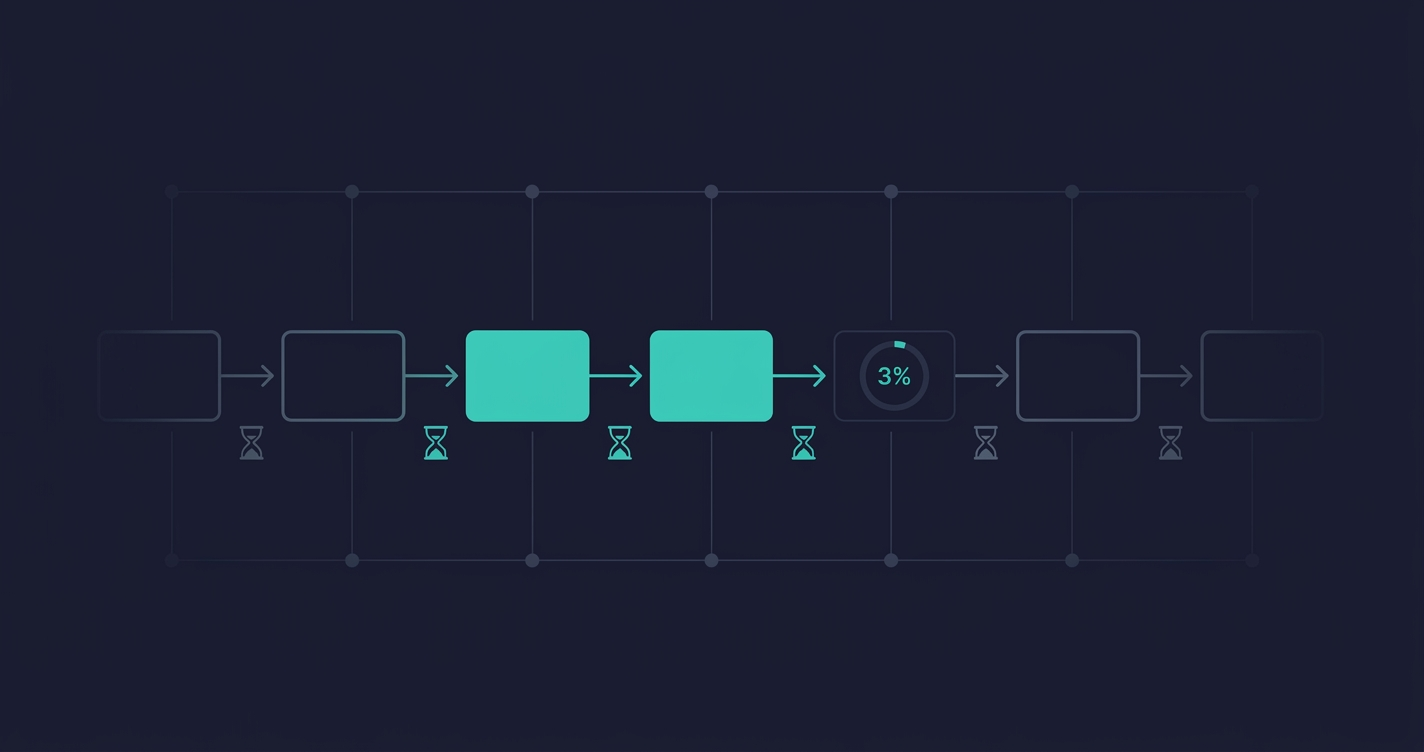
A value stream map does one thing a BPMN diagram never does: it tells you that your 47-day mortgage approval contains roughly 6 hours of actual work. It shows time: the difference between touch time (the minutes or hours a human or system is actively working on a task) and total elapsed time (the calendar time that passes from start to finish, including all queuing, waiting, and handoff delays). The gap between those two numbers is where the 99.3% lives.
That gap is non-value-adding time. Not all of it is avoidable. Regulatory review periods, counterparty response windows, and compliance holds are built into the process by design. But most of it is structural delay: work sitting in queues, files waiting for the next person to open their inbox, approvals stalled because the approver is in a different time zone and the SLA does not require a same-day response.
A process map makes the steps visible. A value stream map makes the time visible. Those are different problems.
Translating VSM from manufacturing to banking
VSM vocabulary is product-centric. Banking teams sometimes resist it because the language feels foreign. The translation is direct.
Manufacturing term → Banking equivalent:
- Product → Customer outcome (approved loan, settled trade, opened account)
- Raw material → Customer application or transaction request
- Inventory → Work queue (applications waiting to be processed)
- Work-in-process (WIP) → In-flight cases across all stages
- Machine → Core banking system, decisioning engine, or compliance platform
- Operator → Relationship manager, credit analyst, operations officer
- Cycle time → Touch time per task (the time someone is actively working)
- Lead time → Total elapsed time from submission to resolution
- Push system → Batch processing (tasks released on a schedule, not on demand)
- Pull system → Event-driven processing (next task triggered when capacity is available)
- Defect → Application error, missing document, data entry mistake requiring rework
- Transportation waste → Unnecessary handoffs between departments or systems
Once the vocabulary maps across, the VSM methodology applies directly. A 23-step loan origination process is no different from a 23-stage manufacturing line. Each step has a touch time. Between each step is a queue. The sum of touch times is value-added time. The total elapsed time is lead time. The ratio is your baseline.
For more context on the types of waste this mapping surfaces, see our post on the 7 types of process waste in banking.
Step-by-step: running a value stream map on a banking process
For a well-scoped process, these five steps fit into a single working session. For complex cross-departmental workflows, expect two to three days of data collection before the mapping session.
Step 1: Choose the right process
Scope is everything. A VSM works best on a process with a defined start point (customer submits application), a defined end point (customer receives outcome), and a measurable customer impact (time to decision, time to funding, time to settlement).
Good candidates for a first VSM in banking: retail loan origination, SME credit renewal, trade finance document checking, mortgage drawdown, account opening for new corporate clients.
Avoid scoping too broadly (the full customer lifecycle) or too narrowly (a single task within one department). The right scope typically spans three to seven departments and has a lead time measurable in days, not minutes.
Step 2: Map the current state with touch time and total time
Walk the process. Interview the people who do the work, not the people who manage it. For each step, capture two numbers: touch time (how long does someone actively work on this task?) and the queue time before it (how long does work sit before someone picks it up?).
Be specific. "We process applications within 24 hours" is a policy statement. "Applications arrive in the morning batch at 9am; the analyst typically opens them between 10am and 11am; the credit memo takes 45 minutes to complete" is data.
Capture the current state on a single page. Use standard VSM notation: process boxes for each step, a timeline at the bottom with touch times above the line and queue times below. The single-page constraint matters—it forces the team to see the whole system rather than optimizing individual steps in isolation.
Step 3: Add queue time at every stage
Queue time is where most of the waste lives, and it is the most frequently omitted measurement. Teams focus on task duration because task duration feels controllable. Queue time feels like someone else's problem. It is the time before the task begins, and no one owns it.
That is exactly why it accumulates.
For each handoff in the process, measure: how long does work wait before the next person acts on it? This includes internal approval queues, system batch cycles, external verification windows, and signature or wet-stamp requirements. Document the reason for each queue. Some queues are mandatory (regulatory review periods). Some are structural (batch processing runs twice daily). Some are cultural (approvers check their queue at end of day).
Mandatory queues cannot be eliminated. Structural and cultural queues frequently can.
Step 4: Calculate the value-added ratio
Sum the touch times across all process steps. Divide by total lead time. Express as a percentage.
Value-added ratio = (Sum of touch times ÷ Total lead time) × 100
If the total lead time for your retail loan origination is 47 days, and the sum of all touch times is 8 hours, your value-added ratio is approximately 1%. The other 99% of the calendar time is queuing, waiting, and administrative processing.
That number is uncomfortable. It is also the only honest starting point for an improvement conversation. Without it, teams argue about reducing the credit analyst's memo from 45 minutes to 30. With it, they realize the memo is not the problem.
Step 5: Design the future state
A future state map is not a wishlist. It is a set of specific, testable changes to the current state, each one justified by the queue and touch-time data from Steps 2 and 3.
Common interventions in banking VSM projects: consolidating sequential approval stages into parallel review, replacing batch-triggered handoffs with event-driven triggers, eliminating duplicate data entry by integrating systems at the point of first capture, and reducing WIP limits so analysts complete cases fully rather than touching many cases partially.
The future state should project touch times, queue times, and a target value-added ratio. That target becomes the baseline. Track actuals against it monthly.
The Kuwait bank worked example: 139 days to 57 days
A regional bank in Kuwait applied VSM methodology to its procurement approval process. The current state map revealed 23 discrete steps and a total lead time of 139 calendar days. Of those 139 days, the single largest concentration of delay sat in two queue points, accounting for roughly 60 days: credit committee scheduling (meetings held fortnightly, meaning cases waited up to 14 days for a slot) and legal sign-off (a single-point dependency on one department head for all transactions regardless of value).
The future state design targeted three specific interventions. First, a pre-submission checklist reduced documentation error rates and cleared the first queue. Second, credit committee review was restructured to allow asynchronous approval for standard cases, reserving committee time for exceptions. Third, legal sign-off authority was delegated for lower-value transactions, removing the single-point dependency for the majority of cases.
The result: 12 process steps, a total lead time of 57 days, a 59% reduction. No new systems were required. The changes were structural: who held approval authority, when decisions were batched versus triggered, and which steps could run in parallel. The VSM surfaced the specific queues. The interventions followed directly from the data.
Your loan origination takes 47 days. How much is actual work?
Most banking operations leaders can tell you their SLA from submission to resolution. Fewer can say how much of that SLA is actual work versus accumulated delay. Almost none have calculated their value-added ratio.
That is not a failing. The measurement requires deliberate effort: walking processes, interviewing the people who actually do the work, timing tasks at a granularity that operations reporting rarely captures. It also does not feel urgent until the ratio is on the page and the team is staring at it together.
The ratio changes conversations in a specific way. A team debating whether to hire another credit analyst, because the process feels slow and the team feels stretched, discovers that the analyst's task takes 40 minutes and the application waits 11 days for that 40-minute task to begin. The constraint is not analyst capacity. It is the approval queue upstream that releases cases in a fortnightly batch.
VSM does not tell teams what to fix. It shows them the system, and the system makes its own constraints visible.
Without a baseline ratio, improvement conversations stay qualitative: "the process is slow," "there are too many handoffs," "the systems don't talk to each other." With a ratio, they become specific: "we need to move from 2% value-added to 8%, which means addressing these three queues, through these interventions, measured monthly against this target." Those are different conversations. The second one ends in a decision.
For a broader look at how VSM fits within a full process optimization programme, see our complete guide to business process optimization in financial services.
How ESSAM accelerates the baseline
A traditional VSM exercise (interviews, process walks, timeline mapping, ratio calculation) takes experienced Lean Six Sigma practitioners two to three weeks for a complex banking process. The output ESSAM delivers in 40 minutes takes a traditional team two to three weeks to produce. Data collection is the bottleneck: coordinating availability across departments, reconciling interview notes into consistent time measurements, validating numbers with process owners.
ESSAM's AI-guided process baseline compresses that timeline. The E-S-S-A-M framework (Eliminate waste, Simplify and Standardize, Automate, Migrate low-value work) uses structured intake, automated timeline reconstruction from existing system logs and workflow data, and guided practitioner interviews to build a current-state value stream map in approximately 40 minutes. The output is a mapped current state with touch times, queue times, a calculated value-added ratio, and a queue-type classification (mandatory, structural, or cultural) for each delay point. That is the starting point traditional VSM takes weeks to reach.
For banks running three or more parallel improvement initiatives, the diagnostic phase is the actual constraint. A team that spends four weeks establishing a baseline for one process has burned a month before designing a single intervention. ESSAM's baseline phase removes that lag: the value-added ratio is on the page at the end of the session. Improvement cycles start sooner, and across multiple initiatives in parallel, the time savings compound.
To see how the baseline phase works in practice, visit how it works.
Frequently asked questions
What is value stream mapping in banking? Value stream mapping in banking is a method for visualizing the flow of work, and the time that flow consumes, from a customer request to a delivered outcome. Unlike a standard process map, a VSM captures both touch time (active work) and queue time (waiting between steps), producing a value-added ratio that reveals how much of total elapsed time is genuine work versus structural delay.
How is value stream mapping different from process mapping? A process map shows steps and sequence: who does what, in what order. A value stream map adds the time dimension: how long each step takes, how long work waits between steps, and the ratio of value-added time to total elapsed time. The difference matters because most banking process waste sits in queues and handoffs, not in the tasks themselves. A process map does not show queues. A VSM does.
What is a good value-added ratio for banking processes? There is no universal benchmark, but ratios below 5% are common in banking operations that have not undergone structured process improvement. Ratios below 2% are more common than most operations leaders expect. High-performing manufacturing operations achieve 25–40%. Banking will never match that ceiling because mandatory regulatory hold periods are non-negotiable. But most banking operations carry substantial structural and cultural waste on top of those mandatory holds. The Kuwait procurement example started at roughly 5%; the Kuwait example also illustrates what most teams discover—the mandatory delays are a small fraction of total elapsed time. The structural and cultural queues are larger, and those are addressable. A ratio below 2% is a strong signal that queue-ownership questions should lead the improvement conversation.
How long does a value stream mapping exercise take? A traditional VSM exercise for a well-scoped banking process—retail loan origination, trade finance document checking, account opening—typically takes two to three weeks including data collection, mapping sessions, and future state design. The data collection phase is usually the bottleneck. AI-assisted approaches like ESSAM's process baseline can compress the current-state mapping to under an hour by automating timeline reconstruction from system data and structuring practitioner interviews efficiently.
Where should a bank start with value stream mapping? Start with a process that has a clear start and end point, a measurable lead time, and direct customer impact. Retail loan origination and SME credit renewal are common first choices because the lead time is visible to customers, the process spans multiple departments, and the improvement case is easy to quantify. Avoid starting with regulatory-constrained processes where mandatory hold periods dominate lead time—the ratio will be low by design, and the improvement levers are limited. Pick a process where structural and cultural waste is likely to be the primary driver.
The number that changes everything
Most banking operations teams do not know their value-added ratio. They know their SLA. They know their throughput. They may know their error rate and rework volume. The ratio—the number that puts all of that into a single honest statement about how the process actually runs—is rarely calculated and rarely visible to leadership.
VSM is not a complex methodology. It requires discipline in measurement and honesty in interpretation. The discipline is: capture touch time and queue time for every step, not just the steps that feel important. The honesty is: when the ratio comes back at 0.7%, or 2%, or 5%, resist the impulse to explain it away. That number is the starting point. It is almost always lower than the team expected.
The Kuwait bank's procurement team did not go looking for a 59% reduction in lead time. They went looking for their ratio. The reduction followed because the map showed exactly which 60 days of delay were structural and ownerless. Two queues. Three targeted interventions. No new systems.
Your ratio exists. You just haven't calculated it yet.
If you want to see your ratio in 40 minutes rather than three weeks, talk to the ESSAM team.